Quick summary, read this first:
Let’s walk through it in plain English so you finish this page knowing where you stand and what to do next.
What is the MATCH list? (a.k.a. the Terminated Merchant File)
The MATCH list is a database run by Mastercard that acquiring banks and payment processors use to spot merchants who’ve been shut down before. When a bank terminates a merchant account for cause, it can report that business to MATCH. The next bank that pulls up your application sees the flag.
The older name, Terminated Merchant File or TMF, means the same thing. So if a processor says you’re “TMF’d” or that you “got MATCH’d,” they’re talking about the exact same database. It sits on the Mastercard network, but acquirers across the card brands rely on it when they decide who to approve.
| Detail | What it means |
|---|---|
| Full name | Mastercard Alert to Control High-Risk Merchants |
| Operator | Mastercard |
| Also called | Terminated Merchant File (TMF) |
| Who can see it | Acquiring banks and payment processors |
| How long a listing lasts | Usually five years |
| Who it affects | The business, its principals, and often the owners personally |
MATCH usually happens after a terminated merchant account (excessive chargebacks, compliance issues, fraud exposure, etc.). It can stay on file …
How does the MATCH list work in payment processing?
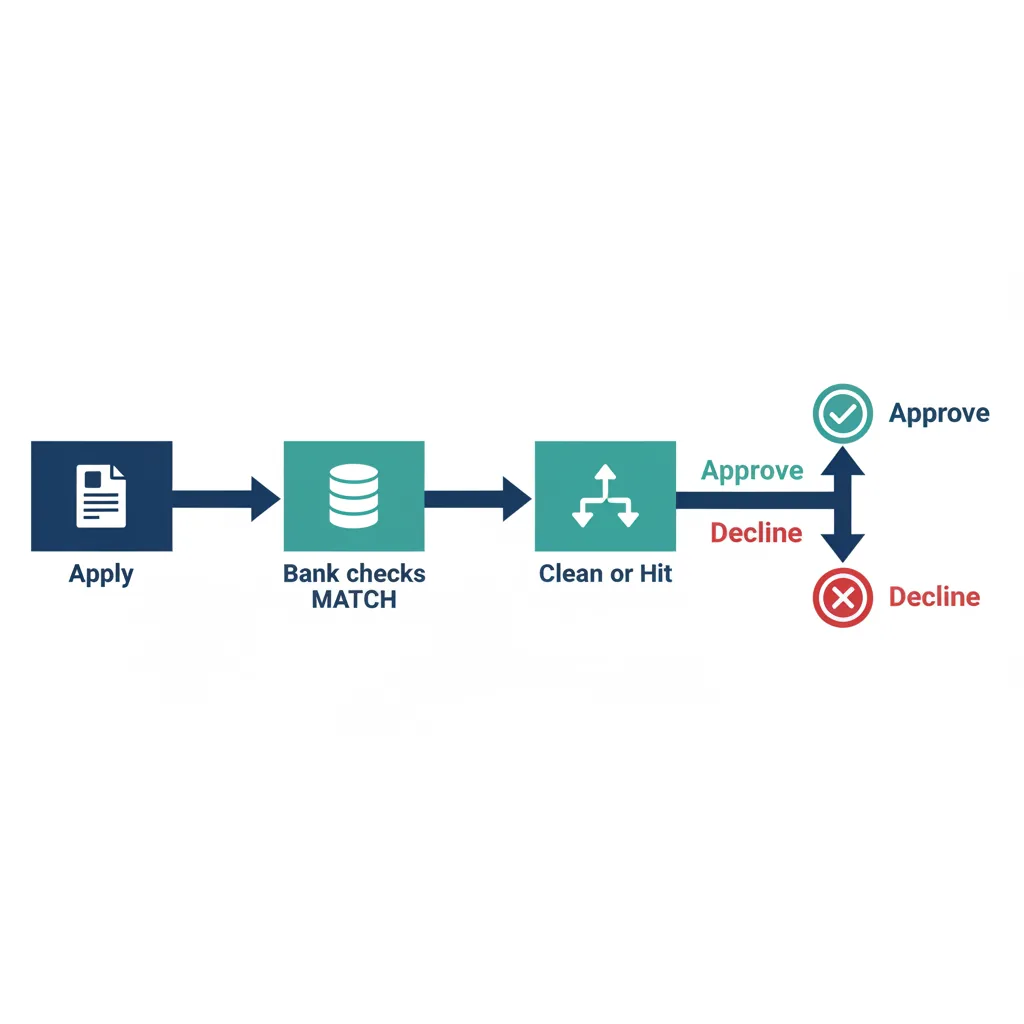
The mechanic is simple. When you apply for a merchant account, the acquirer runs your business name, tax ID, and the owners’ details against MATCH. A clean check moves you forward. A hit usually means an automatic decline, or a much harder look before anyone says yes.
Here’s the part that trips people up: only acquiring banks and processors can add a merchant to MATCH or search it. A business owner can’t log in and check their own status. That single fact shapes almost everything else on this page, including how you find out you’re listed in the first place.
Why do merchants get added to the MATCH list?
Mastercard uses a set of numbered reason codes, and each one describes why a bank pulled the plug. You don’t need to memorize every code. Most listings come down to a handful of triggers, and excessive chargebacks lead the pack. When a merchant’s dispute ratio climbs too high, the Federal Trade Commission and the card networks both read it as a warning sign of fraud or a broken business, and the acquirer often reports the account.
| Reason (plain name) | What it means | Typical trigger |
|---|---|---|
| Excessive chargebacks | Too many customer disputes | Refund problems, unclear billing, fraud |
| Fraud | Fraudulent transactions ran through the account | Stolen cards, fake orders |
| Excessive fraud | Fraud volume crossed a network threshold | Online orders placed with stolen card details |
| Money laundering | Account used to move illegal funds | Suspicious transaction patterns |
| Account data compromise | Card data was exposed or stolen | A breach or weak security |
| Rule violation | Broke the acquirer or card-brand rules | Selling banned products, wrong business type |
Here’s what often gets skipped: you can land on MATCH by mistake or unfairly. High-risk businesses get flagged faster, and a rushed underwriter can misread a legitimate company. Spend ten minutes on a merchant forum or a Reddit thread and you’ll find owners fighting listings they say never should have happened. Keeping a clean dispute record and getting real chargeback and fraud management support is your best defense before it ever gets to that point.
What happens when your business is on the MATCH list?

A listing follows you. New applications get declined, existing accounts can be frozen with little warning, and any Mastercard-network processing gets tough for up to five years. It also creates friction with partners who run their own checks.
| Situation | Not on MATCH | On MATCH |
|---|---|---|
| Applying for a new account | Standard review | Auto-decline or heavy scrutiny |
| Existing account | Runs normally | Risk of a sudden freeze |
| Reserve requirements | Often none or low | Rolling reserve likely |
| Approval odds | High | Low without a specialist |
How to check the MATCH list (am I on it?)
Since you can’t query MATCH directly, here’s the honest route. First, look at your decline reason. If a processor turned you down and mentioned prior termination, that’s a strong signal. Second, and this is the reliable one: ask the acquirer that terminated you. When you request it, they’re required to give you the reason code behind your listing.
A high-risk processor can also pull your status during pre-underwriting, so you learn where you stand before you formally apply. Forums are good for moral support, but the real answer always comes from your acquirer, not a Reddit thread.
How to get off the MATCH list (removal process)
Only the acquirer that added you can take you off. That one rule decides everything about removal. Standard listings expire on their own after five years, but you don’t always have to wait that long.
The MATCH list entry is valid for five years. Only the originator of the entry can remove you from MATCH before that.
| Your situation | Realistic action | Likely outcome | Timeframe |
|---|---|---|---|
| Listed in error | Dispute directly with the listing acquirer | Removal if you prove the mistake | Weeks to months |
| Chargebacks or unpaid balance | Resolve the debt, then request removal | Case-by-case, not guaranteed | Varies |
| Serious cause (fraud, laundering) | Legal escalation as a last resort | Difficult | Often the full five years |
Be wary of anyone who promises to “wipe you off” for a flat fee. If the listing is valid, no one can force a removal, and honest guidance beats a false promise every time.
Can you still process payments while on the MATCH list?
Yes. A MATCH listing doesn’t ban you from accepting cards. It means mainstream processors will pass, so you work with a high-risk-friendly acquirer that underwrites MATCH’d merchants one at a time.
What do those underwriters want to see? Resolved chargebacks, cleaned-up billing, clear documentation of your business, and often a willingness to accept a rolling reserve for a while. Placing hard-to-approve accounts is exactly what we do at Premier Payments Online, from adult and subscription businesses to nutraceutical and telehealth. If you’ve been turned away elsewhere, our high-risk merchant account solutions are built for that conversation.
Once you’re approved, a second account is worth a look. A backup means one frozen account won’t stop your revenue, and payment routing that spreads volume across accounts keeps your processing steady and your risk lower.
How to keep your business off the MATCH list
Prevention is cheaper than removal. The four habits below keep most merchants clear of the list entirely.
| Risk area | What to do | Why it matters |
|---|---|---|
| Chargebacks | Keep your dispute ratio low with clear refunds | Excessive disputes are the top reason for a listing |
| Category coding | Match your business category to what you actually sell | The wrong code reads as hidden or banned activity |
| Billing descriptors | Use a descriptor customers recognize | Confused buyers file disputes instead of asking |
| Fraud monitoring | Screen orders and watch for patterns | Fraud losses push you over network thresholds |
The fraud piece isn’t optional. Federal Reserve research on payments shows card fraud remains a stubborn cost across the system, and every fraudulent sale that slips through pushes your ratios the wrong way. Spreading out how you get paid helps too; adding ACH and check acceptance as an alternative payment rail moves some risk away from card disputes alone.
Key takeaways
- The MATCH list is Mastercard’s database of terminated merchants, once called the TMF, and acquirers check it before approving you.
- Excessive chargebacks are the number one reason merchants get added, and listings usually last five years.
- You can’t check MATCH yourself, but the acquirer that terminated you must give you the reason code on request.
- Removal comes only from the bank that listed you; dispute errors, resolve real debts, and skip anyone promising a guaranteed wipe.
- You can still process payments through a high-risk specialist, and clean billing plus fraud monitoring keeps you off the list going forward.
Ready to talk it through?
We don’t just say no. If you’re on the MATCH list, or worried you might be, we’ll explain the why in plain language and work to find a real path to get you processing again. Talk to a real person about your options and let’s see what we can place for you.