If an ACH return report shows R08, the payment was returned because the account holder placed a stop-payment order on that debit.
R08 does not, by itself, prove that the payment was unauthorized or that the account lacked funds.
For recurring-billing merchants, the safest first step is to pause automated retries, review the original authorization, and contact the account holder before initiating another debit.
R08 Return Code at a Glance
| Question | Answer |
|---|---|
| What does R08 mean? | The ACH debit was returned because the account holder placed a stop-payment order on that entry. |
| Does R08 mean the payment was unauthorized? | No. R08 identifies a stopped payment; it does not automatically establish that the debit was unauthorized. |
| Can a merchant automatically retry it? | No. Pause the account and confirm the authorization, account type, transaction type, and processor requirements first. |
| Does R08 cancel recurring billing? | The code alone does not establish the full scope of the stop-payment request or whether authorization was separately revoked. |
The correct next step can differ for consumer and corporate accounts, so merchants should confirm the process with their ODFI or processor.
What Does the R08 ACH Return Code Mean?
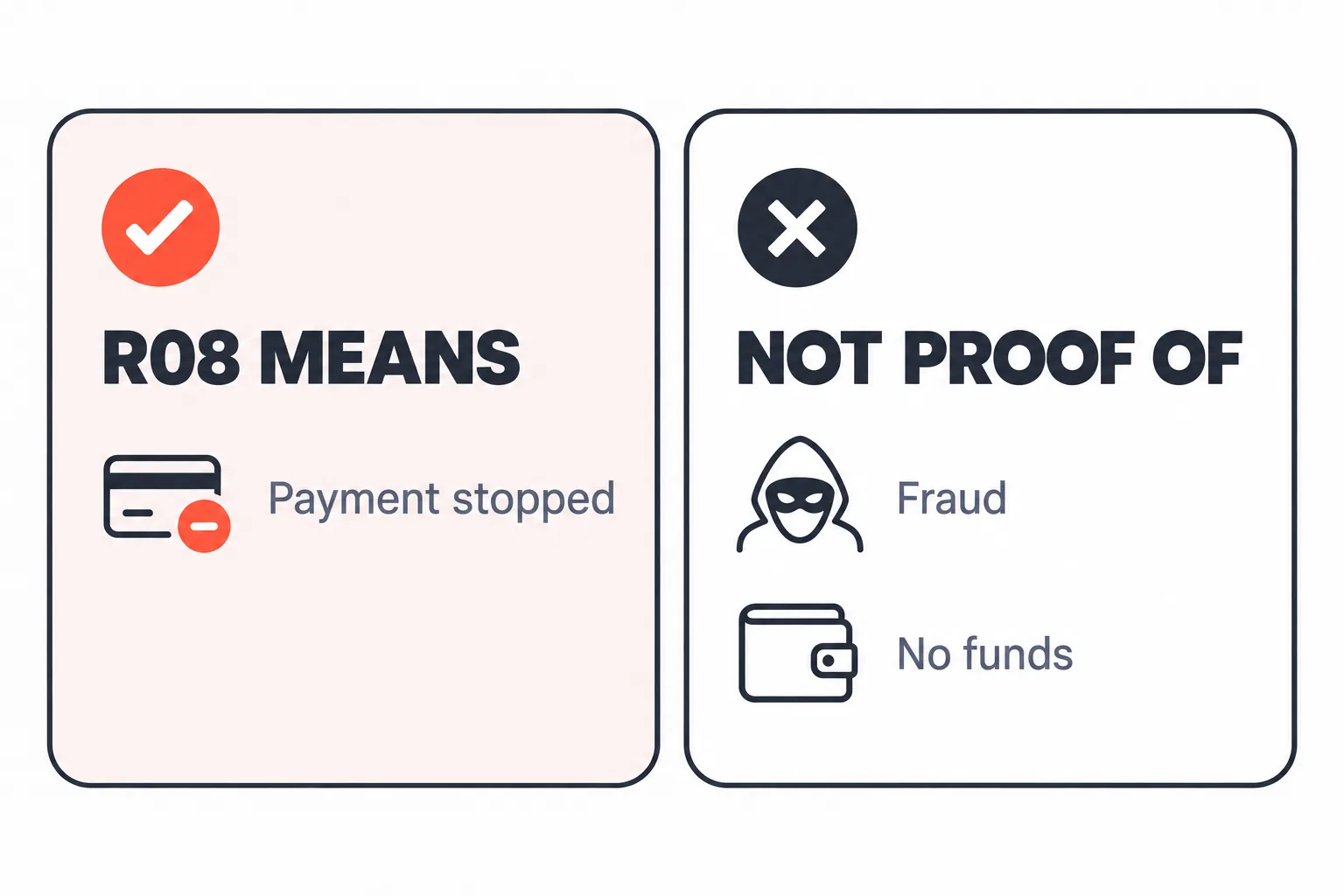
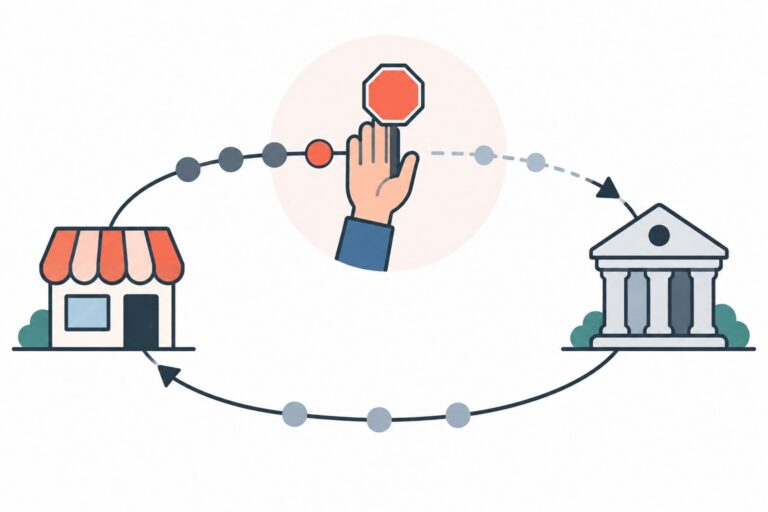
R08 is the ACH return reason code for “Payment Stopped.” It means the receiving bank returned the debit after the account holder placed a stop-payment order on that entry.
R08 does not automatically mean that the bank made an error, the account lacked funds, or the debit was unauthorized. It identifies the reason the payment was returned, not the full reason the account holder wanted the debit stopped.
R08 identifies the returned ACH debit, but the code alone does not confirm whether the customer also revoked the recurring authorization. Pause future debits until the scope of the stop-payment request is clear.
The cash impact can be frustrating: a payment that appeared to settle may later be removed from the merchant’s account. The timing and availability of funds depend on the entry type, processor, settlement date, and bank procedures. For merchants evaluating ACH debit, recurring billing, or eCheck support, PPO describes its ACH and eCheck processing options.
When Does an R08 Return Appear? ACH Settlement, Return Timing, and Funds Availability
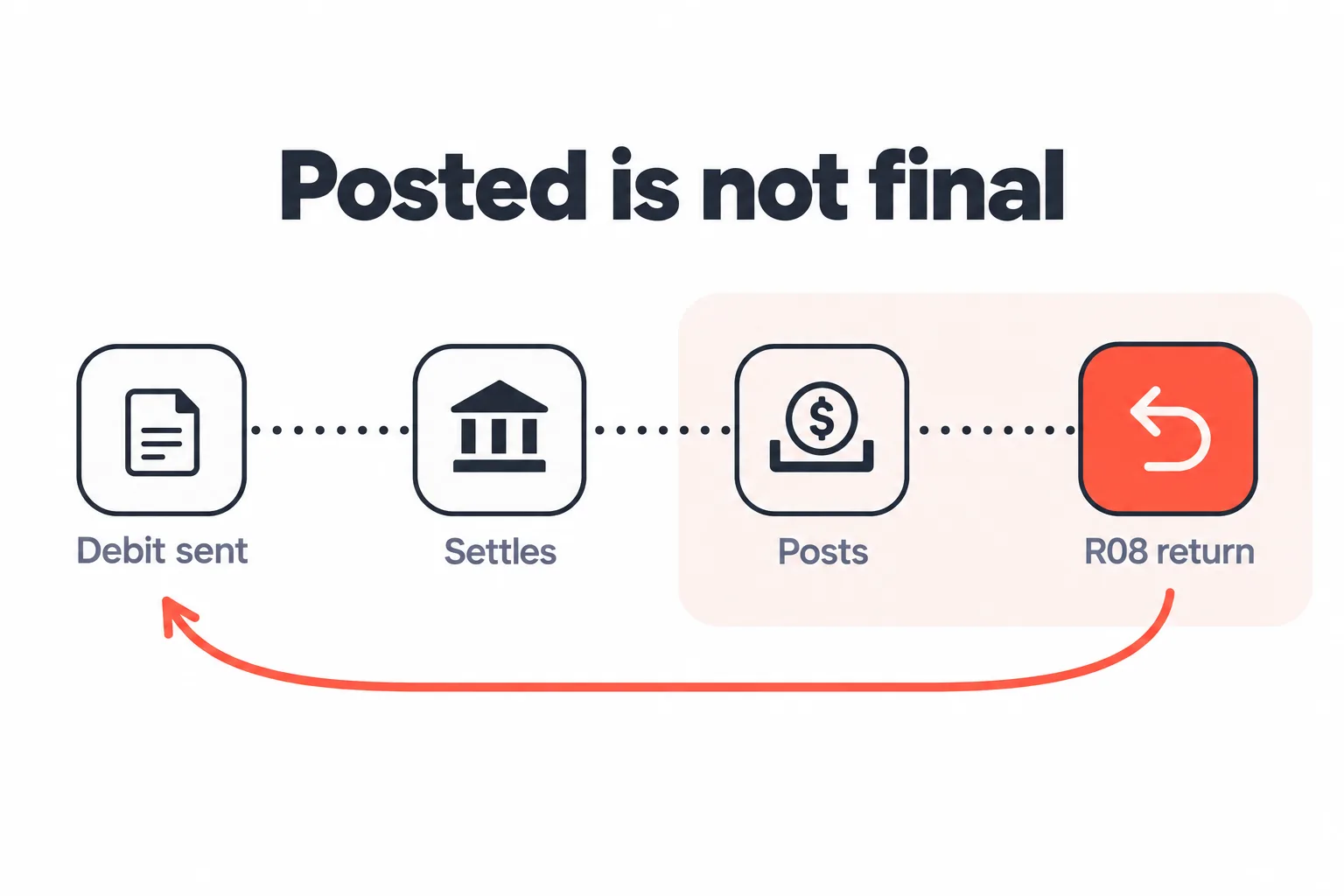
ACH timing depends on the entry type, processing cutoff, settlement date, weekends, holidays, and the merchant’s processor. Standard and Same Day ACH do not create a universal guarantee that funds are immediately final or available to spend.
A return may appear after settlement, but the timing depends on the applicable ACH rules, bank procedures, and processor workflow. Avoid promising a specific R08 return day unless PPO confirms the relevant transaction type and process.
For example, a debit submitted on Monday may settle or return on a different schedule depending on cutoff times, the settlement date, weekends, and holidays. A payment posting to an account is not necessarily the same as funds being final or available to spend.
For recurring merchants, avoid shipping, fulfilling, or unlocking a premium tier solely because an ACH debit appears to have posted. Build a risk-appropriate holding process into ACH-funded fulfillment.
Why an Account Holder May Stop an ACH Debit
Bank-initiated returns can result from account or funding problems. An R08 is different: it indicates that the account holder placed a stop-payment order on the debit. Common reasons include:
- Billing disputes. Wrong amount, wrong date, a duplicate debit, or a charge that landed after they asked to cancel.
- Trial conversions they forgot about. The free month ended, the real price hit, and they panicked.
- Price changes they never noticed. A rate increase buried in an email nobody opened.
- Cancellation friction. If canceling takes three days and a support ticket but calling the bank takes ten minutes, the bank wins.
- An unrecognized descriptor. Your legal entity name shows on the statement, your brand name is what they bought from, and the debit looks like fraud even though it isn’t.
- Service problems. The box never arrived, the app broke, the program wasn’t what they expected.
An R08 may reflect a billing dispute, cancellation problem, or unfamiliar statement descriptor rather than a confirmed fraud claim. Investigate the customer experience before deciding what action is appropriate.
For consumer preauthorized transfers, the CFPB’s Regulation E guidance says the account holder can generally notify the financial institution orally or in writing at least three business days before the scheduled transfer to stop payment. Business-account rules and processor procedures may differ.
How Payment Descriptors Help Customers Identify ACH Debits
The statement may show the company name, company entry description, transaction type, effective date, or trace information. The exact fields visible to the account holder depend on the bank and transaction type.
Nacha’s current Company Entry Description guidance includes a “PURCHASE” description for certain consumer e-commerce ACH debits involving tangible goods, including some recurring tangible-goods subscriptions. Merchants should confirm the applicable requirement before changing descriptors.
Use a descriptor that customers can recognize and provide a support contact that matches the signup, receipt, and statement experience.
R08 vs. R07, R10, R29, R01, R03, R09, and R16
Related readingReturned Mobile ACH Payment: Causes, Consequences & How to Handle ItRead the guide →| Code | Meaning | Merchant response |
|---|---|---|
| R01 | Insufficient funds. | Follow processor-approved retry rules; do not treat it as the same as R08. |
| R03 | No account or unable to locate the account. | Verify the account information instead of assuming the issue is a stop payment. |
| R07 | Authorization revoked by the customer. | Stop future debits until a valid authorization is obtained and the processor approves the workflow. |
| R08 | Payment stopped. | Pause retries and clarify the account holder’s stop-payment instruction. |
| R09 | Uncollected funds. | Follow processor-approved procedures for the specific return reason. |
| R10 | Customer advises that the debit was not authorized. | Investigate the authorization and stop questionable debits. |
| R16 | Account frozen. | Contact the customer or processor; do not assume another debit will succeed. |
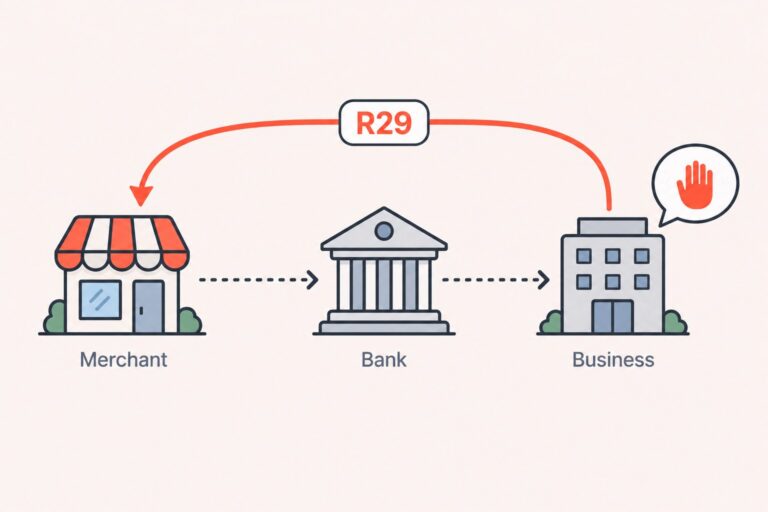
| R29 | Corporate customer advises that the debit was not authorized. | Treat it as a business-account authorization issue and follow processor instructions. |
These distinctions matter because the permissible next step can differ by return reason, account type, authorization, transaction type, and processor instructions.
What to Do Immediately After an R08 Return
1. Kill the automated retry. Pause the next scheduled debit for that customer before your dunning logic does something you’ll regret. 2. Pull the original authorization. Date, method, amount, frequency, and what the customer actually saw when they agreed. 3. Call and email the customer before anything financial happens. Ask what changed. 4. Fix the real issue. Refund the duplicate, correct the amount, honor the cancellation, even when you are technically in the right. 5. Get fresh, documented authorization before attempting any new debit. Do not rely on a casual verbal approval. For consumer preauthorized debits, obtain authorization in the required written or similarly authenticated form, provide the required terms to the consumer, and retain the authorization record. 6. Offer another way to pay so they can clear the balance today: a card, updated bank details, or a local alternative payment method for international customers. 7. Log the outcome so the account doesn’t get quietly re-queued next cycle.
The merchant may incur a processor or bank return fee, and the account holder may face a stop-payment fee from their bank. Fees depend on the applicable agreement and institution.
Can You Reinitiate an ACH Debit After an R08?
Do not automatically resubmit an R08 return. Whether a new debit can be initiated depends on the account type, transaction type, authorization, current Nacha Operating Rules updates, and your ODFI or processor’s instructions.
Do not assume that retry rules for an insufficient-funds return apply to R08. If the account holder wants to pay, follow the authorization and reinitiation process approved for the relevant account and transaction type.
Your billing system should quarantine the account until the authorization, amount, date, and processor-approved next step are documented.
What R08 returns do to your return rate
R08 is not an unauthorized return code, but it may still contribute to broader return-rate monitoring. Categories, thresholds, and consequences depend on the applicable rules, transaction type, processor, acquirer, and merchant agreement.
A rising return rate may lead a processor, acquirer, or sponsoring bank to review the account or adjust account terms. Read a rising R08 count as an early warning about billing communication and customer experience, not as an accounting annoyance.
The same billing habits that produce stop payments can also produce card chargebacks. Review ACH return data and card-dispute data together, while keeping their separate rules and timelines clear.
How to prevent R08 returns: a recurring billing checklist
- Send a pre-debit notice a few days ahead with the exact amount and date. Most stop payments die right here.
- Match your descriptor to your brand, not your holding company.
- Make cancellation genuinely easy, and confirm it in writing the same day.
- Send a change notice whenever the amount or date moves, with enough lead time to react.
- Validate bank details at signup so R03-style data problems don’t pollute your return numbers.
- Space out and cap retries. Aggressive retry logic manufactures disputes.
- Keep clean authorization records: what was shown, when it was agreed, what will appear on the statement.
- Offer more than one way to pay so a stalled bank debit doesn’t become a canceled customer.
For higher-volume or higher-risk merchants, ask the processor whether multiple accounts, routing rules, or backup payment methods are appropriate for the business.
Should Merchants Use ACH Alongside Card Payments?
ACH and card costs depend on the merchant’s pricing model, transaction type, risk profile, and processor. Compare total costs, return handling, dispute exposure, settlement timing, and customer preference instead of assuming one payment rail is always cheaper.
Card problems surface as chargebacks with their own deadlines and evidence rules. Bank-debit problems surface as return codes such as R08.
A payment mix should reflect the merchant’s customers, transaction sizes, risk profile, and processor rules. Some merchants use cards for convenience and ACH for eligible recurring payments, but the right structure depends on the business. PPO describes online payment solutions that include recurring billing, smart transaction routing, reporting, and alternative payment options.
For customers outside the United States, a local alternative payment method or direct bank-to-bank option may be more appropriate than a U.S.-style ACH debit. Availability and cost depend on the business, acquirer, processor, and destination market.
R08 return code FAQ
Frequently asked questions
What does the R08 ACH return code mean?
Is R08 the same as an unauthorized ACH payment?
Does R08 cancel a recurring ACH authorization?
Can a merchant retry an ACH payment after R08?
What is the difference between R07 and R08?
Is R08 a chargeback?
How long does an R08 return take?
How can merchants prevent R08 returns?
Need Help Reviewing ACH Returns?
R08 returns are a signal to review the full billing experience: the descriptor, authorization, cancellation process, pre-debit notice, retry logic, and payment mix.
If recurring billing is generating returns or chargebacks, Premier Payments Online can discuss ACH and eCheck processing, gateway options, recurring-billing tools, and risk-management solutions. PPO also works with high-risk merchants, but availability depends on processor requirements and underwriting. Contact PPO to discuss the right setup for your business.
This article is educational and does not replace the merchant agreement, processor instructions, current Nacha requirements, or qualified legal advice.
Written by Irini Tomei, Principal CEO at Premier Payments Online.