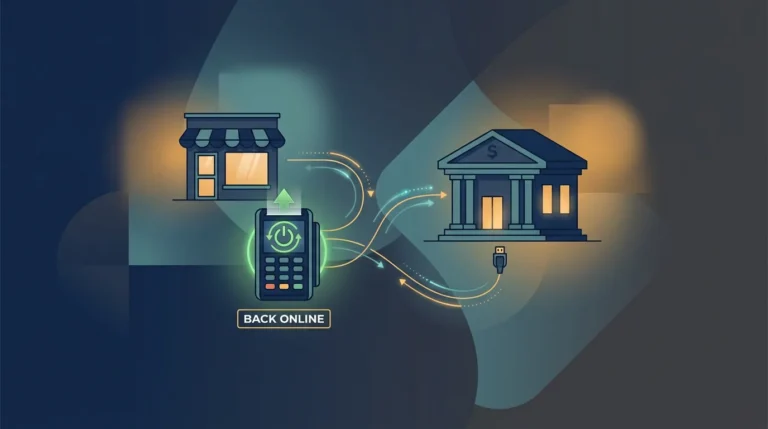
If a mainstream processor just froze your CBD sales, you are not doing anything wrong. You are selling a product that banks treat with extra caution, and that puts you squarely into high-risk payment processing for CBD businesses. The good news: a proper merchant account solves the problem for good, and many providers also offer a cash advance program to help eligible CBD businesses maintain healthy cash flow while growing. Getting approved is more predictable than most declined sellers expect.
What you’ll learn in this guide:
- Why CBD gets labeled high risk, and why mainstream processors drop these accounts
- What a compliant CBD merchant account actually includes
- Realistic rate and fee ranges compared with standard processing
- The exact documents underwriters ask for before they approve you
- How ACH and backup accounts keep revenue flowing
- Key takeaways and where to get placed if you have already been declined
Why Is a CBD Business Considered High Risk?
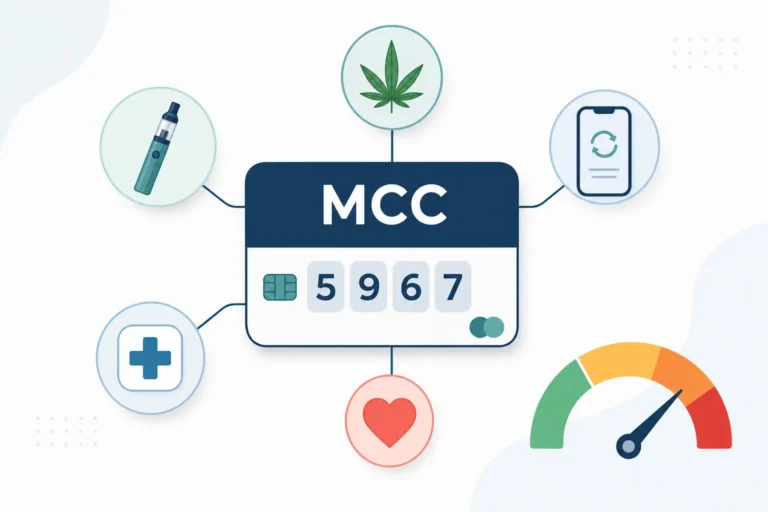
CBD sits in the high-risk bucket because of legal ambiguity, chargeback exposure, and bank caution, not because the business is doing anything shady. Even hemp-derived CBD that is fully legal at the federal level carries paperwork and reputational baggage that a coffee shop never deals with.
The federal line comes from the 2018 Farm Bill and the USDA’s Domestic Hemp Production Program, which legalized hemp containing no more than 0.3% THC on a dry-weight basis. Anything above that line is still treated as marijuana. On top of that, the FDA has not approved CBD as a food additive or dietary supplement for most uses, so the regulatory picture stays unsettled. Banks read that uncertainty as risk, and card brands price for it.
For your account, that means you need a processor that already works with hemp and CBD, not one that will panic the first time a compliance team reviews your file. This is the same reason banks flag certain merchants as high risk across dozens of industries, from supplements to subscription billing.
Why Do Stripe, Square, and PayPal Shut Down CBD Sellers?
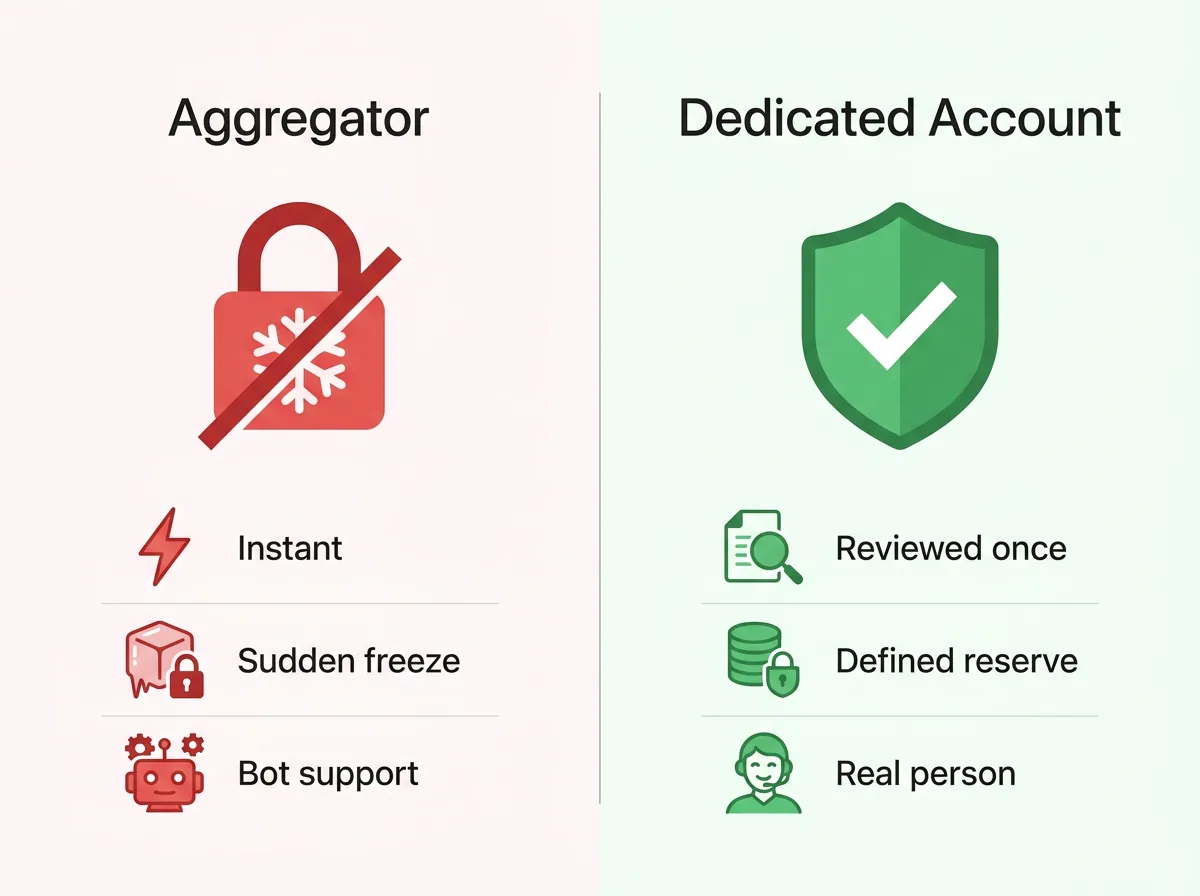
Aggregators use one shared risk profile for millions of sellers, so CBD gets swept out under a blanket policy, often after money has already come in. Stripe, Square, and PayPal are built for volume and speed, not for reviewing each merchant individually. When their systems flag a CBD product, the account gets frozen or closed with little warning, and held funds can sit for weeks.
That sudden freeze is the real danger. You lose the ability to accept cards and, worse, you may lose access to money already collected while a reserve is sorted out. A dedicated high-risk merchant account works differently: a real underwriter reviews your business up front, so you are not living one algorithm away from a shutdown.
| Factor | Aggregator (Stripe / Square / PayPal) | Dedicated High-Risk Account |
|---|---|---|
| Approval | Instant, but reversible | Reviewed once, built to last |
| CBD policy | Prohibited or restricted | Supported |
| Held funds risk | High, sudden freezes | Defined reserve terms |
| Support when trouble hits | Automated, hard to reach | A person who answers |
At Premier Payments Online we do not just say “no” and hang up. When an account is tricky, we explain why and work to find a route that fits your business.
What Does a Compliant CBD Merchant Account Include?
A proper CBD account pairs a high-risk-friendly acquiring bank with a payment gateway, fraud tools, and chargeback support built for the vertical. It is more than a way to swipe a card. You get a dedicated merchant ID (MID), support for major card brands, an online checkout and in-store option, and a billing descriptor set up so customers recognize the charge and do not dispute it out of confusion.
Reserves sometimes come up in these accounts. A reserve is a small portion of sales the bank holds temporarily as a cushion against chargebacks, and it is released back to you on a schedule. It is normal, not a penalty, and a good processor explains the terms in plain language before you sign.
If you want the full picture of documentation, gateways, and product rules, our payment processing guide for CBD businesses walks through it step by step. Adding fraud screening and chargeback management to the account from day one keeps small problems from becoming account-closing ones later.
What Does CBD Payment Processing Actually Cost?
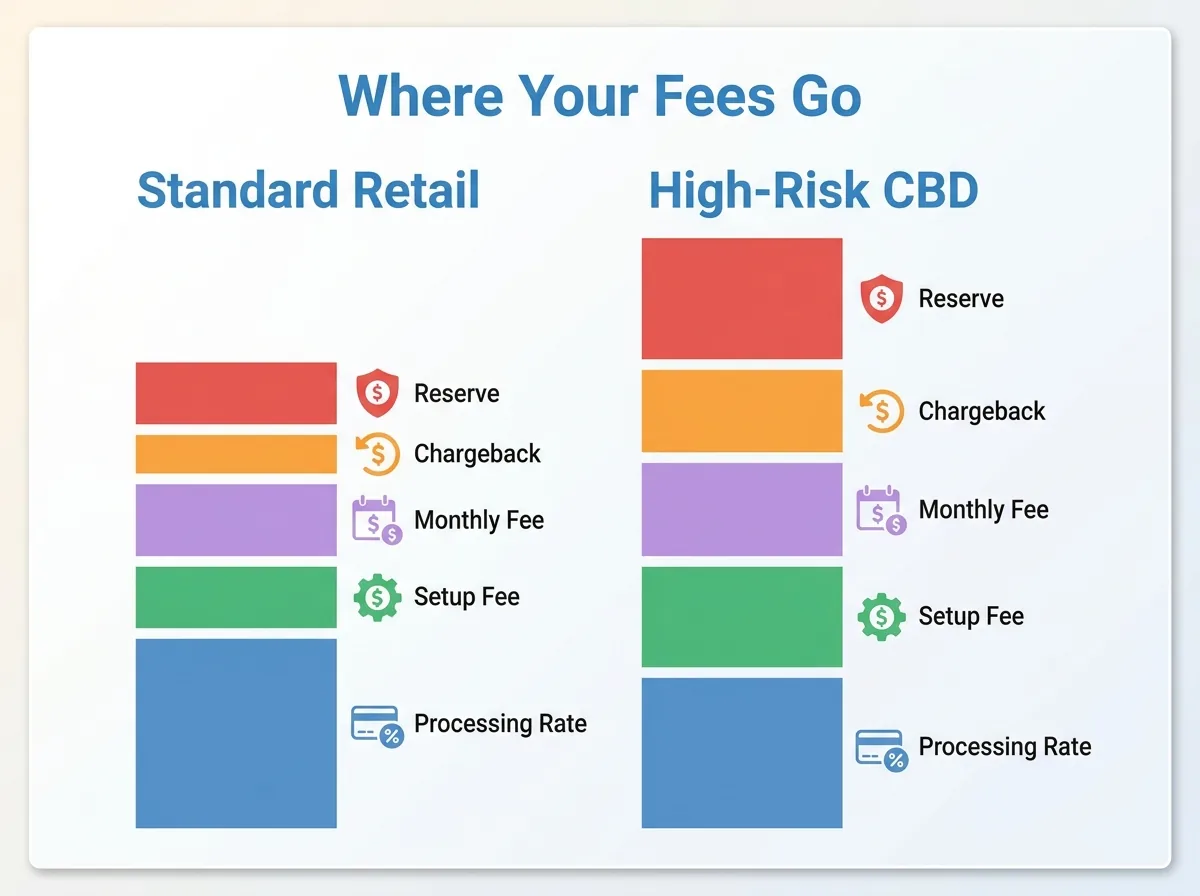
High-risk CBD rates run higher than standard retail because banks price for the added risk, but the gap is smaller than most declined merchants expect. A typical low-risk retail shop might see blended card fees on the lower end, while the average credit card processing fees for merchants in high-risk categories sit a bit above that. The exact number depends on your volume, product mix, and chargeback history.
Rather than quote a single figure, here is how the cost of credit card processing usually breaks down for a CBD account versus a standard one.
| Cost component | Standard retail | High-Risk CBD |
|---|---|---|
| Processing rate | Lower end | Moderately higher |
| Setup fee | Often none | Sometimes applies |
| Monthly account fee | Low | Low to moderate |
| Chargeback fee | Standard | Standard, watched closely |
| Reserve | Rarely | Sometimes, released on schedule |
When you compare credit card processing rates across providers, look past the headline number to the whole picture: setup, monthly, chargeback, and reserve terms together tell you the real average cc processing fee you will pay. A slightly higher rate with stable approval usually beats a cheap rate that gets shut off in month two.
What Do Underwriters Need to Approve Your CBD Account?
Approval speeds up when you hand underwriters a clean file: lab results, compliant labeling, and proof your products stay under the legal THC limit. This is the step most competitors gloss over, and it is where a detail-oriented processor saves you weeks.
| Document | Why underwriters want it | Common reason it gets rejected |
|---|---|---|
| Certificate of Analysis (COA) | Confirms product contents and THC level | Missing, expired, or not covering all products |
| Proof of under 0.3% THC | Meets the federal legal limit | Result sits above the line |
| Product photos and labels | Verifies packaging and claims | Labels missing required info |
| Business and processing history | Shows stability and volume | High past chargeback ratios |
Labeling matters more than sellers realize. The FDA prohibits unapproved health and disease claims on CBD products, and a site promising a product “cures” or “treats” a condition can sink an otherwise clean application. Fixing that language before you apply is exactly the kind of trouble we help you stay out of.
How Do You Keep the Money Moving With ACH and Backup Accounts?
Cards are not the only rail. ACH and eCheck acceptance give CBD sellers a lower-cost backup and a safety net if a card account hiccups. Bank-to-bank ACH payments carry lower fees than cards, which helps on larger orders and recurring billing.
A common question is how long an ACH transfer takes. Standard ACH settles in a business day or two, while Same-Day ACH clears within the same business day, during the set daily processing windows the ACH network runs on.
| ACH type | Typical settlement |
|---|---|
| Standard ACH | 1 to 2 business days |
| Same-Day ACH | Same business day, within set windows |
Setting up ACH and eCheck acceptance alongside cards gives you a second way to collect. Many CBD merchants also add a second card MID for redundancy, so one processing hiccup never stops revenue entirely. It is a simple optimization that pays off during the busy months.
How Do You Stay Approved? Chargebacks and Fraud
Most CBD accounts do not get closed for being CBD. They get closed for chargeback ratios creeping over the card-brand threshold. Keep that ratio low and your account stays healthy for years.
The tactics are practical: use a clear billing descriptor so customers recognize the charge, keep delivery confirmation on every order, answer the phone and emails fast so a frustrated buyer calls you instead of the bank, and post a plain refund policy. Layering fraud screening on top catches bad transactions before they turn into disputes. Our overview of secure payment processing every business needs covers the tools that keep both fraud and chargebacks in check.
Talk to a Team That Finds Solutions
We answer the phone and the emails, and we never just say “no.” If Stripe or Square shut you down, or you are opening a CBD store and want to skip that headache entirely, talk to a high risk payment processing team that finds a route to approval. We will look at your products, your history, and your goals, then place you with a bank built for this work.
Key Takeaways
| Question | Short answer |
|---|---|
| Why is CBD high risk? | Legal ambiguity and bank caution, not wrongdoing |
| Can I get a real merchant account? | Yes, through a high-risk-friendly acquiring bank |
| What does it cost? | Modestly higher than standard retail, worth the stability |
| What documents do I need? | COA, under 0.3% THC proof, product photos, business history |
| How do I stay approved? | Keep chargebacks low and labeling compliant |