What You’ll Discover Today
This guide breaks down exactly what credit card processing fees cost in 2025, using real current data from Visa, Mastercard, and major processors. You’ll learn the true rates for different transaction types, how recent fee increases affect your bottom line, and practical strategies to reduce costs. We cover the latest interchange rate changes, hidden fees to watch for, and industry-specific pricing. Plus, you’ll discover which pricing models actually save money and how to negotiate better rates.
The Real Cost of Credit Card Processing Fees in 2025
Let’s cut straight to the numbers that matter. Credit card processing fees typically range between 1.5% and 3.5% of the transaction amount, but that’s just the starting point. The actual cost depends on your business type, transaction method, and the cards your customers use.
| Fee Component | Typical Range | Who Gets Paid |
| Interchange Fees | 1.15% – 2.80% + $0.05-$0.10 | Card-issuing banks |
| Assessment Fees | 0.13% – 0.15% | Card networks (Visa, Mastercard) |
| Processor Markup | 0.10% – 1.00% + $0.10-$0.30 | Payment processors |
| Total Cost | 1.5% – 3.5% | Combined fees |
Here’s what this means for your business: if you process $10,000 monthly, you’re paying $150-$350 just in credit card processing fees. For a business doing $100,000 monthly, that’s $1,500-$3,500 every single month.
Recent Fee Increases Hit Hard
In 2024, credit card companies in the U.S. earned a record $148.5 billion from processing fees charged to merchants. Merchants paid a record $172 billion in payment processing fees in 2023, with $170 billion going to interchange and assessment fees alone.
Visa raised its Misuse of Authorization Fee from $0.09 to $0.15, while Mastercard increased its Excessive Authorization Attempts Fee from $0.30 to $0.50. These might seem small, but they add up fast for high-volume businesses.
Current 2025 Interchange Rates by Card Network
Interchange rates are updated twice yearly (April and October), and the latest changes show no mercy for business owners. Here are the current ranges for each major network:
Visa Interchange Rates
- Standard credit cards: 1.51% + $0.10 (card-present retail)
- Rewards cards: 1.65% – 2.40% + $0.10
- Business cards: 1.89% – 2.95% + $0.10
- Online transactions: Add 0.10% – 0.30% premium
Mastercard Interchange Rates
- Consumer credit: 1.45% – 2.90% + $0.05-$0.10
- World/World Elite cards: 1.85% – 2.50% + $0.10
- Commercial cards: 1.89% – 2.95% + $0.10
- B2B VIP (new 2025 rate): 2.95% + $0.10 (increased from 1.20% + $60.00)
| Card Network | Lowest Rate | Highest Rate | Assessment Fee |
| Visa | 1.15% + $0.05 | 2.60% + $0.10 | 0.14% |
| Mastercard | 1.45% + $0.05 | 2.90% + $0.10 | 0.1375% |
| American Express | 1.80% + $0.10 | 3.25% + $0.10 | 0.15% |
| Discover | 1.55% + $0.05 | 2.45% + $0.10 | 0.13% |
Why These Rates Matter
American Express is consistently the most expensive network to accept, while Mastercard offers the lowest rates for transactions over $1,000. But don’t just look at the percentages – the fixed fees hit small transactions hard.
Business Type Makes a Huge Difference
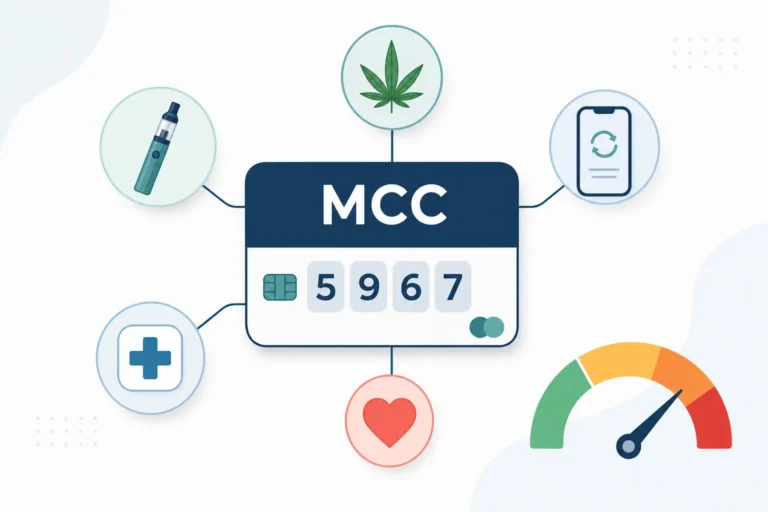
Your merchant category code (MCC) dramatically affects your credit card processing fees. Some industries pay significantly more due to perceived risk levels. If you are not sure where your business falls, our breakdown of what your merchant category code means for fees walks through which MCCs get flagged as high-risk and how that shows up in your rates.
Low-Risk Industries (Lower Fees)
- Retail stores: 1.3% – 2.7%
- Restaurants: 1.4% – 2.8%
- Gas stations: 1.2% – 2.5%
- Grocery stores: 1.1% – 2.3%
High-Risk Industries (Higher Fees)
- Online businesses: 1.8% – 3.5%
- Subscription services: 2.1% – 3.8%
- Travel agencies: 2.0% – 3.6%
- Adult entertainment: 3.0% – 5.0%
| Industry Category | Average Processing Fee | Risk Level | Additional Considerations |
| Retail (card-present) | 1.5% – 2.5% | Low | Lowest fraud risk |
| E-commerce | 2.2% – 3.2% | Medium-High | Higher chargeback rates |
| Restaurants | 1.6% – 2.8% | Low-Medium | Tip adjustments complicate processing |
| Professional services | 1.7% – 2.9% | Medium | Larger average transactions |
Retail businesses pay the lowest credit card processing fees (1.3-2.7%), since in-person transactions carry lower fraud risk. E-commerce rates are higher (1.8-3.5%) due to online fraud concerns.
Card-Present vs Card-Not-Present: The Cost Gap
The way customers pay makes a massive difference in your fees. Card-not-present transactions cost significantly more because of fraud risk.
Card-Present Transactions (In-Person)
- EMV chip transactions: Lowest rates
- Contactless/tap payments: Slightly higher than chip
- Swiped cards: Higher risk, higher fees
- Manually keyed with card present: Highest card-present rates
Card-Not-Present Transactions (Remote)
- Online payments: 0.10% – 0.30% premium over card-present
- Phone orders: Similar to online rates
- Mail orders: Highest CNP rates
- Recurring billing: Special rates available
| Transaction Method | Rate Premium vs Card-Present | Fraud Risk Level |
| EMV Chip | Baseline (lowest) | Very Low |
| Contactless/Tap | +0.05% – 0.10% | Low |
| Card Swipe | +0.10% – 0.15% | Medium |
| Online/Keyed | +0.20% – 0.50% | High |
| Phone/Mail Order | +0.30% – 0.60% | Very High |
Businesses accepting online or keyed-in payments face higher costs, typically between 2.25% and 2.50%, compared to in-person transactions. This difference exists because card-not-present transactions have higher fraud rates and chargebacks.

Pricing Models: Which One Actually Saves Money
Payment processors use different pricing structures, and choosing the wrong one costs thousands annually. Here’s how they really work and which saves money:
Flat-Rate Pricing
- How it works: One rate for all transactions (e.g., 2.9% + $0.30)
- Best for: New businesses with low volume
- Cost: Usually the highest overall rates
- Examples: Square (2.6% + 15¢), PayPal (2.9% + $0.30)
Interchange-Plus Pricing
- How it works: Actual interchange rate + fixed processor markup
- Best for: Established businesses with consistent volume
- Cost: Most transparent and often cheapest
- Example: Interchange + 0.20% + $0.10
Tiered Pricing
- How it works: Transactions are categorized into qualified/mid/non-qualified tiers
- Best for: Very few businesses (often misleading)
- Cost: Often the most expensive due to tier manipulation
- Qualified rates: 1.5% – 2.5%, Non-qualified: 3.0% – 4.5%
| Pricing Model | Monthly Volume Sweet Spot | Average Total Cost | Transparency Level |
| Flat-Rate | Under $5,000 | 2.6% – 3.5% | High |
| Interchange-Plus | Over $10,000 | 1.8% – 2.8% | Very High |
| Tiered | Not recommended | 2.2% – 4.0% | Low |
| Membership/Subscription | Over $50,000 | 1.6% – 2.4% | High |
Interchange-plus pricing is often the least expensive option for high-volume businesses. However, it also has the greatest variability. This pricing structure offers lower costs for higher volumes but requires understanding your statements.
Hidden Fees That Destroy Your Budget
Credit card processing fees include more than just transaction percentages. These additional charges can double your actual costs:
Monthly and Annual Fees
- Statement fees: $5 – $25 monthly
- PCI compliance fees: $5 – $50 monthly
- Account maintenance: $10 – $30 monthly
- Annual fees: $50 – $300 yearly
Per-Transaction Add-Ons
- Gateway fees: $0.05 – $0.30 per transaction
- Authorization fees: $0.02 – $0.10 per transaction
- Batch fees: $0.10 – $0.25 per batch
- Address verification: $0.05 – $0.15 per check
Penalty and Special Fees
- Chargeback fees: $20 – $100 per dispute
- Non-sufficient funds: $25 – $50 per occurrence
- Early termination: $200 – $500
- Equipment lease: $15 – $50 monthly
| Hidden Fee Category | Typical Cost | Impact on $10K Monthly Volume |
| Monthly account fees | $25 – $75 | $300 – $900 annually |
| PCI compliance fees | $10 – $30/month | $120 – $360 annually |
| Chargeback fees | $25 – $75 per dispute | $300 – $900 for 1% chargeback rate |
| Equipment fees | $20 – $60/month | $240 – $720 annually |
Look out for hidden fees like PCI compliance, early termination, and chargeback fees. These can add $500-$2,000 annually to your processing costs.
Industry-Specific Rate Negotiations
Different industries have unique leverage points for negotiating better credit card processing fees. Understanding your industry’s specific factors helps secure better rates.
Restaurant and Food Service
- Advantage: High transaction volume, repeat customers
- Negotiation points: Average ticket size, tip processing efficiency
- Special considerations: Tip adjustments, quick-service vs full-service rates
Retail and E-commerce
- Advantage: Predictable transaction patterns
- Negotiation points: Seasonal volume fluctuations, return policies
- Special considerations: Card-present vs online transaction mix
Professional Services
- Advantage: Large average transaction amounts
- Negotiation points: Low chargeback rates, business-to-business focus
- Special considerations: Invoice payments, recurring billing needs
| Industry Focus | Key Negotiation Leverage | Potential Savings |
| High-volume retail | Consistent monthly processing | 0.10% – 0.30% reduction |
| Professional services | Large transaction amounts | 0.15% – 0.40% reduction |
| Restaurants | Predictable peak times | 0.05% – 0.25% reduction |
| E-commerce | Growth trajectory | 0.20% – 0.50% reduction |
For businesses requiring specialized payment processing, Premier Payments Online offers online payment solutions designed to optimize rates across different business models and transaction types.
How to Calculate Your True Processing Costs
Most business owners don’t know their real processing costs because they only look at the advertised rates. Here’s how to calculate your actual expense:
Step 1: Find Your Effective Rate. Total monthly fees ÷ Total monthly volume = Effective rate
Step 2: Include All Hidden Costs
- Add monthly fees, PCI fees,and statement fees
- Include equipment costs and gateway fees
- Factor in chargeback and penalty fees
Step 3: Calculate Annual Impact Effective rate × 12 months + annual fees = True yearly cost
| Monthly Volume | Advertised Rate | Hidden Fees | True Effective Rate |
| $10,000 | 2.9% + $0.30 | $75 | 3.65% |
| $25,000 | 2.9% + $0.30 | $100 | 3.30% |
| $50,000 | 2.9% + $0.30 | $150 | 3.20% |
| $100,000 | 2.9% + $0.30 | $200 | 3.10% |
The difference between advertised and actual rates can be 0.5% – 1.0%, costing thousands annually for most businesses.
Strategies to Reduce Credit Card Processing Fees
Smart business owners don’t just accept high processing fees. Here are proven methods to cut costs:
Encourage Lower-Cost Payment Methods
- Offer cash discounts (but follow state regulations)
- Promote debit cards over credit cards
- Use ACH payments for recurring transactions
- Implement digital wallet incentives
Optimize Transaction Processing
- Use EMV chip readers for all card-present transactions
- Implement Address Verification Service (AVS) for online sales
- Submit transactions with complete Level II/III data for B2B sales
- Process transactions in real-time rather than batch processing
Negotiate Better Terms
- Get multiple quotes from processors
- Leverage your processing volume for better rates
- Review and renegotiate annually
- Eliminate unnecessary monthly fees
| Cost Reduction Strategy | Potential Savings | Implementation Difficulty |
| Switch to interchange-plus pricing | 0.20% – 0.60% | Medium |
| Encourage debit card use | 0.50% – 1.00% | Easy |
| Optimize online fraud prevention | 0.10% – 0.30% | Medium |
| Negotiate monthly fees | $20 – $100/month | Easy |
| Use Level II/III data | 0.20% – 0.50% for B2B | Hard |
Provide Level II and III transaction data for lower rates, especially in B2B transactions. This detailed information can reduce interchange rates by 0.20% – 0.75% for qualifying transactions.
Legal Ways to Pass Fees to Customers
Surcharging customers for credit card use is legal in most states, but there are strict rules to follow:
Cash Discount Programs
- List prices include processing fees
- Offer discounts for cash payments
- Legal in all 50 states
- Must clearly communicate pricing
Credit Card Surcharges
- Add fees only to credit card transactions
- Cannot exceed actual processing costs
- Illegal in Connecticut, Massachusetts, and Puerto Rico
- Require a 30-day advance notice to processors
Convenience Fees
- Charge for non-standard payment channels
- Common for phone or online payments
- Must be clearly disclosed
- Cannot exceed actual costs
| Fee Passing Method | Legal Status | Maximum Fee | Disclosure Requirements |
| Cash discount | Legal nationwide | No limit | Clear pricing displays |
| Credit card surcharge | Legal in 47 states | Actual processing cost | 30-day processor notice |
| Convenience fee | Legal nationwide | Actual additional cost | Point-of-sale disclosure |
2 in 3 Americans say they would not use their credit card if they were charged a fee for doing so. More than 3 in 5 people believe it’s unfair for merchants to pass their payment processing fees on to their customers.

Future of Credit Card Processing Fees
Several trends are reshaping credit card processing fees, and smart business owners prepare for these changes:
Regulatory Pressure
- Congressional bills targeting interchange fees
- Potential caps on processing rates
- Increased transparency requirements
- State-level surcharge regulations
Technology Changes
- Real-time payment adoption
- Cryptocurrency integration
- Enhanced fraud prevention
- Mobile payment optimization
Market Competition
- New payment processors entering the market
- Fintech companies offering lower rates
- Bank partnerships changing dynamics
- International payment network expansion
| Trend | Timeline | Potential Impact on Fees |
| Federal interchange regulation | 2025-2027 | Could reduce fees 0.20% – 0.50% |
| Real-time payment adoption | 2024-2026 | May increase processing competition |
| Enhanced fraud prevention | Ongoing | Could reduce risk-based premiums |
| New market entrants | Continuous | Downward pressure on processor markups |
With legislation to limit swipe fees still under debate on Capitol Hill, the credit card swipe fee battle isn’t going away anytime soon.
Choosing the Right Payment Processor
Your choice of payment processor significantly impacts your total credit card processing fees. Here’s what to evaluate:
Rate Structure Comparison
- Request interchange-plus quotes from multiple processors
- Compare total costs, not just advertised rates
- Evaluate monthly fee structures
- Assess contract terms and requirements
Service and Support Quality
- 24/7 customer support availability
- Technical integration assistance
- Dispute and chargeback support
- Account management quality
Technology and Features
- Modern payment gateway capabilities
- Mobile payment support
- Reporting and analytics tools
- Fraud prevention features
| Processor Evaluation Factor | Weight | Key Questions |
| Total cost | 40% | What’s the true effective rate, including all fees? |
| Contract terms | 25% | Are there long-term commitments or penalties? |
| Technology | 20% | Does the platform integrate with your systems? |
| Support | 15% | Is help available when you need it? |
For businesses seeking transparent pricing and comprehensive payment solutions, Premier Payments Online offers in-store processing with competitive rates and no hidden fees. Our omni-channel solutions integrate seamlessly across all payment channels.
Credit Card Processing Fees by Transaction Size
Transaction size dramatically affects your effective processing rate due to the fixed fee component of interchange rates:
Small Transactions (Under $10)
- Fixed fees represent a larger percentage of the total
- Effective rates can exceed 5% – 6%
- Consider minimum purchase amounts
- Encourage cash for very small purchases
Medium Transactions ($10 – $100)
- Most common business transaction range
- Standard interchange rates apply
- Optimize for card-present processing
- Focus on fraud prevention
Large Transactions (Over $100)
- Fixed fees become a negligible percentage
- May qualify for commercial card rates
- Enhanced data submission is beneficial
- Consider cash discount programs
| Transaction Amount | Effective Rate Impact | Recommended Strategy |
| $5 purchase | 6.0% – 8.0% | Cash discount or minimum |
| $25 purchase | 3.0% – 4.0% | Standard processing |
| $100 purchase | 2.5% – 3.5% | Optimize card-present |
| $500 purchase | 2.0% – 3.0% | Level II/III data |
| $2,000 purchase | 1.8% – 2.8% | B2B optimization |
Ticket size has a huge impact on a business’s average credit card processing fees. As the ticket size decreases, the number of transaction fees incurred increases.

Key Takeaways for Business Owners
Credit card processing fees are complex, but understanding the structure helps you make smarter decisions and save money. The typical range of 1.5% – 3.5% is just the starting point – your actual costs depend on numerous factors.
Interchange rates are non-negotiable, but processor markups are completely within your control. Focus your negotiation efforts on monthly fees, contract terms, and markup percentages rather than trying to reduce interchange costs.
Choose the right pricing model for your business size. Flat-rate pricing works for small businesses, but interchange-plus pricing almost always costs less for established businesses processing over $10,000 monthly.
Don’t ignore hidden fees – they can double your actual processing costs. Statement fees, PCI compliance charges, and equipment costs add up quickly. Always calculate your true effective rate, including all fees.
Consider your customer payment preferences when implementing cost-saving strategies. While cash discounts and surcharges can offset processing costs, they may also reduce sales if customers prefer card payments.
Regularly review your processing costs and market options. Interchange rates change twice yearly, new processors enter the market constantly, and your business needs evolve. An annual review ensures you’re not overpaying.
Invest in technology that reduces your processing costs. EMV terminals, fraud prevention tools, and systems that submit enhanced transaction data all help qualify for lower rates.
Plan for future changes in the payment landscape. Real-time payments, cryptocurrency, and regulatory changes will all impact processing costs in the coming years.
For high-risk businesses, specialized processing may be necessary, but it doesn’t have to be expensive. Work with processors who understand your industry and can offer competitive rates despite higher risk classifications.
Remember that payment processing is a business expense that enables sales. The goal isn’t to eliminate all processing costs but to optimize them while maintaining customer satisfaction and payment security.
Tired of overpaying for credit card processing? Premier Payments Online offers transparent pricing with no hidden fees and competitive rates across all business types. Our payment experts will analyze your current costs and show you exactly how much you can save. Contact us today for a free consultation and discover why thousands of businesses trust us for their payment processing needs.
Frequently Asked Questions
What are the average credit card processing fees for small businesses in 2025?
Credit card processing fees typically range from 1.5% to 3.5% of each transaction, with the exact amount depending on factors like card type, processing method, and business industry. For a $100 transaction, you’d pay $1.50 to $3.50 in processing fees. Small businesses often pay higher effective rates due to lower processing volumes and less negotiating power with processors.
How much do Visa and Mastercard interchange fees cost in 2025?
Visa interchange rates range from 1.15% + $0.05 to 2.40% + $0.10 per transaction, while Mastercard rates span 1.45% + $0.05 to 2.90% + $0.10. These rates are updated twice yearly in April and October. The exact rate depends on factors like card type (rewards cards cost more), transaction method (online costs more than in-person), and merchant category.
Why do online transactions have higher credit card processing fees?
Online transactions carry a higher fraud risk because the physical card isn’t present for verification. Card-not-present transactions typically cost 0.20% to 0.50% more than in-person transactions. This premium exists because online transactions have higher chargeback rates and require additional fraud prevention measures, making them riskier for card issuers and payment networks.
Can I negotiate credit card processing fees with my processor?
You cannot negotiate interchange rates set by Visa, Mastercard, and other card networks, but you can negotiate processor markups, monthly fees, and contract terms. Focus on reducing the processor’s markup (typically 0.10% to 1.00%), eliminating monthly fees, and securing better contract terms. Businesses processing over $10,000 monthly have the most negotiating leverage.
What hidden fees should I watch for in credit card processing?
Common hidden fees include monthly statement fees ($5-$25), PCI compliance fees ($5-$50), chargeback fees ($20-$100 per dispute), early termination fees ($200-$500), and equipment lease fees ($15-$50 monthly). These fees can add $500-$2,000 annually to your processing costs. Always request a complete fee schedule before signing with any processor.
Is it legal to charge customers credit card processing fees?
Credit card surcharges are legal in 47 states (illegal in Connecticut, Massachusetts, and Puerto Rico) but must not exceed your actual processing costs and require a 30-day advance notice to your processor. Cash discount programs are legal nationwide and offer customers discounts for non-card payments. Convenience fees for non-standard payment channels are also legal with proper disclosure.
Which pricing model offers the lowest credit card processing fees?
Interchange-plus pricing is typically the most cost-effective for businesses processing over $10,000 monthly, offering transparency and lower total costs. Flat-rate pricing (like Square’s 2.6% + 15¢) works better for smaller businesses or those with unpredictable volume. Avoid tiered pricing as it often results in higher costs due to transaction categorization manipulation.
How do different credit card types affect processing fees?
Rewards cards, business cards, and premium cards have higher interchange rates than basic credit cards. Debit cards typically cost 0.50% to 1.00% less than credit cards to process. American Express is usually the most expensive network (1.80% to 3.25%), while Mastercard often offers the lowest rates, especially for large transactions over $1,000.
What’s the difference between interchange fees and assessment fees?
Interchange fees (1.15% to 2.80%) go to the bank that issued the customer’s card and make up the largest portion of processing costs. Assessment fees (0.13% to 0.15%) go to the card networks (Visa, Mastercard, etc.) to maintain their payment infrastructure. Both are non-negotiable, while processor markups (0.10% to 1.00%) can be negotiated.
How can I reduce my credit card processing fees without changing processors?
Encourage debit card use over credit cards, implement EMV chip readers for all in-person transactions, use Address Verification Service for online sales, and submit Level II/III transaction data for B2B sales. Consider offering cash discounts or ACH payments for recurring transactions. These strategies can reduce costs by 0.20% to 1.00% without switching processors.
Do high-risk businesses pay more for credit card processing?
Yes, high-risk industries like online businesses, subscription services, and adult entertainment typically pay 0.50% to 2.00% more than low-risk retail businesses. This premium compensates for higher chargeback rates and fraud risk. However, specialized high-risk processors often offer better rates than traditional processors for these business types.
How often do credit card processing fees change?
Interchange rates are updated twice yearly by card networks in April and October. Assessment fees change less frequently, usually annually. Processor markups can change based on your contract terms, but most agreements lock rates for 1-3 years. It’s important to review your processing costs annually and renegotiate when contracts expire.