NFC tap-to-pay has become one of the fastest-growing methods for Americans to complete everyday transactions. This guide breaks down what is NFC mobile payment, how the underlying technology works, why it’s secure, and how U.S. consumers and businesses use Near Field Communication to move money with almost no friction.
It also explains NFC payment adoption trends, real security considerations, and what merchants need before accepting mobile wallets or contactless cards. Additionally, it also covers merchant requirements, adoption trends, and deeper comparisons between NFC, QR codes, and EMV chip cards.
What is NFC? The Technology Behind Contactless Payment
Near Field Communication, commonly shortened to NFC, is a short-range wireless communication standard that allows two devices to exchange data when positioned very close to one another.
The technology operates at 13.56 MHz and evolved from RFID, but NFC offers two-way encrypted communication designed for secure actions such as mobile payments and identity verification. According to the NFC study, the transmission range stays within roughly 4 centimeters, which reduces interference and lowers security risk by design.
When U.S. merchants upgraded their point-of-sale systems over the past decade, many terminals began supporting NFC capabilities. This shift positioned NFC as an essential part of modern contactless payments, a category that includes tap-to-pay cards, mobile wallets such as Apple Pay and Google Pay, and NFC-enabled wearables.
How NFC Mobile Payments Work? From Tap to Confirmation
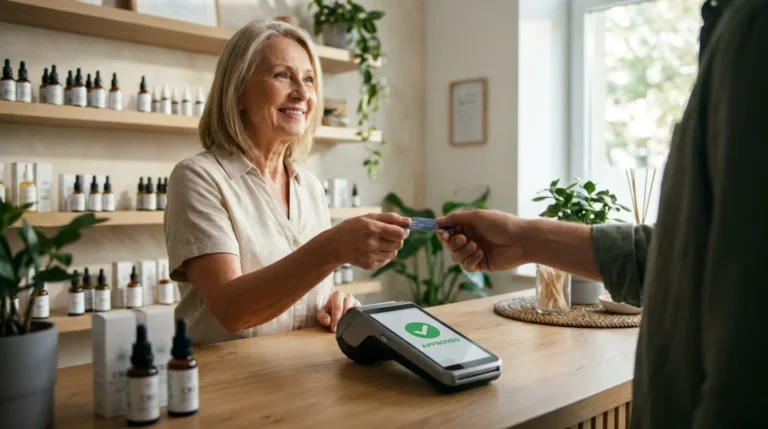
Understanding what is NFC mobile payment starts with the way a mobile device communicates with a payment terminal. When a phone, smartwatch, or NFC card approaches the reader, the terminal produces a small electromagnetic field. That field powers the NFC antenna in the device for a moment, allowing the two to authenticate and exchange secure payment credentials without revealing the card number.
The wallet app generates a unique, one-time token that stands in for the actual card data. Apple, Google, and Samsung adopt the same tokenization model used by EMV chip cards. The token travels through the encrypted payment network, is authorized by the card issuer, and is returned to the merchant terminal as an approved transaction. No sensitive card information appears during the process.
Authentication layers vary by device. Many smartphones require Face ID, Touch ID, or a passcode. Others allow double-tap shortcuts followed by biometric verification. Smartwatches use wrist-detection systems paired with secure elements embedded in the hardware.
The result looks seamless to consumers: a tap, a vibration, a beep, and a receipt. Underneath that convenience sits a sophisticated stack of encryption, tokenization, issuer validation, and device authentication.
Why NFC Mobile Payments Are Rising Across the U.S.
The U.S. adoption rate for mobile and contactless payments has climbed quickly. According to a 2024 Federal Reserve Payments Insight Brief, the share of U.S. businesses using digital wallets rose from 47% to 62% between 2022 and 2023, highlighting how quickly wallet-based payments are spreading in the commercial sector.
According to Visa’s Fiscal 2023 Annual Report, the U.S. has passed 40% contactless penetration, with more than 520 million Visa tap-to-pay cards in circulation.
NFC mobile payments offer different advantages depending on whether you’re on the buying or selling side, but both groups see clear improvements in convenience, speed, and overall experience.
Benefits of NFC Mobile Payments for Consumers and Merchants
| Consumers | Merchants |
| Faster checkout with minimal wait time. | Quicker transactions that reduce line buildup. |
| No physical card handling or touching shared surfaces. | Less friction during the payment process improves customer flow. |
| A mobile wallet can store cards, loyalty accounts, transit passes, and IDs in one place. | A smoother checkout experience for customers who prefer digital wallets and tap-to-pay. |
| NFC payments can be disabled instantly if a device is lost or stolen, offering added security. | Stronger support for omnichannel setups where online, in-store, and mobile payments need unified processing. |
| A greater sense of safety when compared with carrying a physical wallet. | Access to integrated solutions, such as in-store terminals, online systems, and unified payment tools through providers like Premier Payments Online. |
These combined advantages help explain the continued rise of tap-to-pay usage across U.S. retail, transit, hospitality, and service environments.

NFC vs. QR Code Payments
To illustrate how NFC differs from alternative contactless methods, the comparison below outlines the practical and technical distinctions between NFC vs QR code payments.
| Feature | NFC Mobile Payments | QR Code Payments |
| Technology Type | Short-range wireless radio communication (Near Field Communication). | Visual code scanning using a smartphone camera. |
| Interaction Method | Tap or hold the device/card near the terminal. | Open the camera or payment app and scan the QR image. |
| Speed | Near-instant; typically faster than all other mobile payment methods. | Slower due to the app loading and scanning process. |
| Security | Encrypted tokenization, device authentication, and secure elements. | Varies by app; QR codes can be vulnerable to spoofing if not verified. |
| Equipment Needed | NFC-enabled phone, smartwatch, or card + NFC terminal. | QR code displayed or printed + phone with camera. |
| Offline Use | Limited without device power or terminal connectivity. | Can work offline if the QR link contains static payment information. |
| Typical Use Cases | Retail checkout, transit, restaurants, tap-to-pay terminals. | Peer-to-peer payments, small vendors, invoices, and remote payments. |
This comparison shows why NFC became the dominant method for in-person transactions, while QR codes remain popular for remote or app-based payments.
Security, Tokenization, and Encryption: Why NFC is Considered Safe
Security concerns always arise when discussing what is NFC mobile payment, but the underlying structure is far more secure than older magnetic-stripe transactions. NFC uses tokenization to protect sensitive card details.
During a transaction, the device sends a single-use token to the payment terminal rather than exposing the real credit card number. Apple, Google, and Samsung encrypt this data inside secure elements or use host card emulation protected by hardware-based security.
Payment tokenization, a method used by standards bodies such as EMVCo, replaces sensitive card data with a randomized token. Because the token does not expose the card number, intercepted token data cannot be used for unauthorized transactions, significantly reducing fraud risk.
Research shows that relay attacks on NFC-enabled payment systems are technically feasible, even using off-the-shelf smartphones, though real-world exploitation depends heavily on timing, device proximity, and whether readers or wallets deploy countermeasures.
Because defenses such as tokenization, secure elements, timeouts, or distance-bounding may reduce risk, documented large-scale fraud remains uncommon. Yet security experts continue to highlight relay attacks as a valid concern for contactless payments. For merchants, compliance still matters. PCI standards apply whether a business accepts tap-to-pay or traditional card entry. Companies often rely on structured risk and fraud management programs or dedicated PCI guidance to maintain compliance, limit chargebacks, and protect customer information.

Limitations and Practical Challenges of NFC Payments
The growth of NFC across the U.S. does not eliminate its controls. Consumers need NFC-enabled smartphones or cards, and not every shopper activates NFC on their device. Certain Android phones allow users to disable the feature entirely, which can lead to confusion at checkout.
From a merchant perspective, terminals must support NFC-enabled devices. Although most modern U.S. payment terminals now include NFC antennas, older equipment in small shops or rural regions may not. Businesses also face infrastructure maintenance requirements, software updates, and compliance responsibilities associated with contactless transactions.
Some users express concern about accidental taps or unintentional charges, yet payment terminals require deliberate proximity and timing to complete a transaction. The combination of user authentication and secure elements significantly reduces such risk.
How NFC Compares with EMV Chip Transactions
Many Americans still insert EMV chip cards, so the following comparison helps clarify how NFC tap-to-pay differs from traditional chip-based transactions.
NFC vs. EMV Chip (Insert Chip Cards)
| Feature | NFC Tap-to-Pay | EMV Chip (Insert Card) |
| Interaction Style | Contactless tap, device, or card held near the terminal. | The card is inserted and kept in place until authorization completes. |
| Transaction Speed | Fastest of all card-present methods. | Moderate; takes a few seconds for chip reading and issuer validation. |
| Security Model | Tokenized digital credentials, protected by device biometrics. | Chip generates dynamic data; secure but requires physical insertion. |
| User Experience | No physical card handoff; works with phones, watches, wearables. | Traditional card entry; not compatible with mobile devices. |
| Wear and Tear | No physical contact with the reader, reducing card damage. | Frequent insertions can wear out the chip or terminal slot. |
| Adoption Growth | Rapid rise due to mobile wallets and contactless cards. | Mature and universal, but not growing at the same pace. |
This comparison makes clear why merchants and consumers increasingly prefer tap-to-pay when both options are available.
What Merchants and Consumers Should Know Before Using NFC Payments
Consumers activating NFC on their smartphones should understand basic security practices. Using device-level biometric authentication adds an essential layer of protection. Keeping software updated and monitoring transaction histories helps prevent misuse. Most wallet apps provide near-real-time push notifications, which give users the ability to flag unauthorized activity immediately.
For merchants, adopting NFC requires payment terminals that support contactless technology, up-to-date software, and compatible processing partners. Many organizations prefer working with processors that offer secure routing and specialized support for industries with complex requirements. Payment providers that support high-risk merchants, recurring billing, ACH programs, or intelligent routing make NFC acceptance more seamless.
When upgrading systems, merchants often review PCI compliance requirements. Resources such as compliance testing, attestation support, and documentation help businesses meet standards designed to safeguard customer data. Companies offering structured guidance on PCI compliance and fraud prevention play a central role in supporting stable contactless ecosystems.

Conclusion: Why NFC Mobile Payments Matter in the U.S.
The question of what is NFC mobile payment reflects more than curiosity about a tap-to-pay gesture. It signals the broader shift toward secure, tokenized, wireless transactions that reduce friction in everyday commerce.
Near Field Communication allows U.S. shoppers to pay through smartphones, watches, or contactless cards without exposing sensitive card information. Adoption continues to climb as Americans grow more comfortable with digital wallets and as retailers upgrade their payment terminals.
As the ecosystem expands, NFC stands as a key component of the nation’s payment landscape. Its short-range communication, encryption standards, and ease of use make it one of the most reliable forms of contactless transactions available today.
For businesses, NFC acceptance pairs naturally with modern online payments, integrated retail systems, and risk-managed processing partners. For consumers, it offers a fast, secure, and familiar way to complete purchases across the country.