International ACH payment processing has quietly become one of the most practical ways for businesses to move money across borders without the heavy fees tied to traditional wire transfers. Built on the automated clearing house network, this system supports global transactions, recurring payments, and cross-border settlements while maintaining lower costs and reliable compliance standards.
This guide breaks down how it works, what makes it different, and why businesses rely on it today.
International ACH Payment Processing
International ACH payment processing refers to the transfer of funds between bank accounts across different countries using systems connected to the Automated Clearing House network. Unlike domestic ACH, which operates within a single country, international ACH payments, often called IAT ACH transactions, move through global banking partners while still using electronic funds transfer infrastructure.
At its core, international ACH payment processing is an extension of traditional ACH banking. It supports cross-border payments, currency conversion, and compliance requirements while keeping costs lower than international wire transfers. Financial institutions rely on standardized formats developed by NACHA, which works alongside regulatory bodies like the Office of Foreign Assets Control (OFAC) to ensure compliance and security.
For businesses that operate globally, international ACH payment processing offers an effective way to send and receive funds without exposing themselves to excessive transaction fees or operational complexity.
What Is ACH, and How Does the Automated Clearing House Works?
To understand international ACH payment processing, it helps to start with the basics. ACH stands for Automated Clearing House, a network that processes electronic payments between banks. In simple terms, ACH is a system that moves money electronically from one account to another without paper checks or manual handling.
An ACH payment is a type of electronic funds transfer. When someone asks what ACH is or what ACH stands for in banking, the answer points to this centralized network that processes transactions in batches. These batches move through ACH operators such as the Federal Reserve or private networks.
ACH transactions fall into two categories. An ACH credit pushes money into an account, such as payroll deposits. An ACH debit pulls funds from an account, such as subscription payments. This distinction matters in international ACH payment processing, where both transaction types may occur across borders.
The ACH network handles billions of payments annually. According to NACHA, more than 30 billion ACH payments were processed in 2022, highlighting how central this system has become to modern banking.
How International ACH Transfers Work Across Borders
International ACH payment processing follows a structured flow, though it involves more steps than domestic transfers. The process begins with the originating bank, which receives payment instructions from a business or individual. That bank sends the transaction through the ACH operator, where it enters a system that connects to international banking partners.
From there, the payment moves to a foreign receiving bank. Currency conversion often occurs at this stage, depending on the destination country. The receiving bank credits the funds to the beneficiary’s account after completing compliance checks.
International ACH transactions, also known as IAT transactions, require additional data fields. These include information about both the sender and recipient, as well as details about the foreign bank account. This extra layer exists to meet regulatory requirements and reduce financial crime risks.
Here’s what makes international ACH payment processing different. It blends domestic ACH infrastructure with global banking networks. That hybrid model allows businesses to handle cross-border payments while maintaining the efficiency of electronic funds transfer systems.
International ACH vs Wire Transfers vs EFT Payments
A common question in banking is how ACH compares with wire transfers and EFT payments. While all three involve moving money electronically, they differ in cost, speed, and use case.
| Feature | ACH Payment | Wire Transfer | EFT Payment |
| Cost | Low (a few dollars) | High ($25–$50+) | Medium |
| Speed | 2–5 days (international), 1-3 days (or same-day/next-day for domestic) | Same day (Domestic) | Varies (Depends on Type (Instant to 5 days)) |
| Use Case | Recurring, payroll, bulk payments | Urgent transfers | All digital transfers |
| Security | High (EFTA protection) | Very high (but irrevocable) | High |
ACH payment processing suits businesses that prioritize cost efficiency over speed. Wire transfers serve urgent transactions where timing matters more than fees. EFT acts as a broader category that includes ACH, wire, and other electronic transfers.
When comparing EFT vs ACH, ACH operates as a specific type of EFT. When comparing ach vs wire, the main difference lies in cost and speed. That distinction plays a major role in international ACH payment processing decisions.

Benefits of International ACH Payment Processing for Businesses
When businesses expand beyond local markets, the cost and complexity of moving money often become a quiet but serious problem. International ACH payment processing offers a more balanced approach. It doesn’t compete on speed alone; instead, it focuses on stability, cost control, and consistency over time.
| Benefit Area | What It Means in Practice | Why It Matters for Businesses |
| Cost Efficiency | Lower transaction fees than wires | Helps control long-term expenses |
| Payment Consistency | Batch processing with predictable cycles | Easier financial planning |
| Recurring Payments | Supports automated billing and payroll | Reduces manual work |
| Cross-Border Capability | Enables international ACH payment processing through bank partnerships (e.g., U.S. to Canada, Europe) | Offers a lower-cost alternative to wires, though coverage depends on partner networks |
| Integration Flexibility | Works with invoicing and billing systems | Streamlines finance workflows |
| Risk Reduction | Built-in compliance and monitoring | Safer cross-border transactions |
Another point worth noting is how well international ACH payment processing fits into digital workflows. Businesses already using automated billing or invoice processing for enterprise systems often find ACH integration easy. It becomes part of the system rather than an extra step.
That’s really where the value shows up, not just in savings, but in how smoothly payments fit into everyday operations.
Common Use Cases for International ACH Payments
Not every business uses international ACH payment processing the same way. Some rely on it quietly in the background, while others build entire payment strategies around it. The common thread is that it works best where payments repeat, scale, or need to stay cost-efficient.
Take global payroll as an example. Companies with remote teams often need a reliable way to send salaries without absorbing heavy transfer fees. ACH makes that manageable. It may not be instant, but it’s dependable.
Then there are subscription businesses. Monthly billing across countries can quickly become expensive if handled through card networks or wires. ACH debit transactions provide a steady alternative.
| Use Case | How ACH Is Applied | Business Impact |
| Global Payroll | Salary payments to international employees | Reduces overhead costs |
| SaaS Subscriptions | Recurring billing across regions | Improves payment predictability |
| Freelancer Payouts | Payments to remote contractors | Simplifies cross-border payouts |
| Vendor Payments | Regular supplier settlements | Maintains stable cash flow |
| Membership Platforms | Automated recurring charges | Supports scalable revenue models |
| Marketplace Payments | Bulk disbursements to users | Handles volume efficiently |
There’s also a growing use among digital platforms. Marketplaces, for instance, need to move funds between multiple parties across borders. ACH helps manage that flow without adding unnecessary friction.
Businesses that combine ACH with recurring payment processing solutions often notice a shift. Payments become less of a task and more of a background function that simply works.
ACH Processing Time, Fees, and Settlement
The timing of international ACH payment processing depends on several factors, including destination country, banking partners, and compliance checks. While domestic ACH transactions typically settle within one to two business days, international ACH payments take longer.
| Payment Type | Processing Time | Cost |
| Domestic ACH | 1–2 days | Low |
| International ACH | 2–5 days | Low to medium |
| Wire Transfer | Same day | High |
Fees for ACH payments remain lower than most alternatives. However, currency conversion and intermediary bank charges may affect the final amount received. Exchange rates also play a role, especially in cross-border transactions.
Businesses that want to better understand payment timing often look into how long ACH transfers take, including typical settlement windows and the factors that can influence processing speed.
Security, Compliance, and Risk in International ACH
Security remains a central concern in international ACH payment processing. NACHA enforces strict rules to ensure transactions meet compliance standards. These include requirements for data accuracy, transaction monitoring, and fraud prevention.
OFAC screening plays a key role in international transactions. Financial institutions must verify that payments do not involve restricted entities or sanctioned countries. This requirement adds an extra layer of protection but also contributes to processing time.
Fraud risks exist in any payment system, but ACH includes safeguards to reduce exposure. Businesses often adopt tools for payment fraud prevention to detect unusual activity and protect sensitive data.
Encryption and tokenization further enhance security. Many companies rely on payment tokenization to secure payment details and reduce the risk of data breaches. Combined with a secure payment gateway, these measures create a safer environment for global transactions.
Challenges of International ACH Payment Processing
While international ACH payment processing offers clear advantages, it isn’t without trade-offs. The system wasn’t designed for urgency. It was built for efficiency, and that difference shows in certain situations.
Timing is one of the first things businesses notice. Payments don’t move instantly. Instead, they follow processing cycles, which can feel slow if speed is the priority. For routine transactions, that’s usually fine. For urgent transfers, it can be limiting.
Coverage is another factor. Not every country connects seamlessly to ACH-style systems. In some cases, businesses need to combine ACH with other methods to complete transactions.
| Challenge Area | What Happens | Business Consideration |
| Processing Speed | Takes several business days | Not ideal for urgent payments |
| Global Coverage | Limited in some regions | May require hybrid payment methods |
| Currency Conversion | Exchange rates affect final amount | Impacts cost predictability |
| Compliance Requirements | Additional data needed for IAT | Requires accurate documentation |
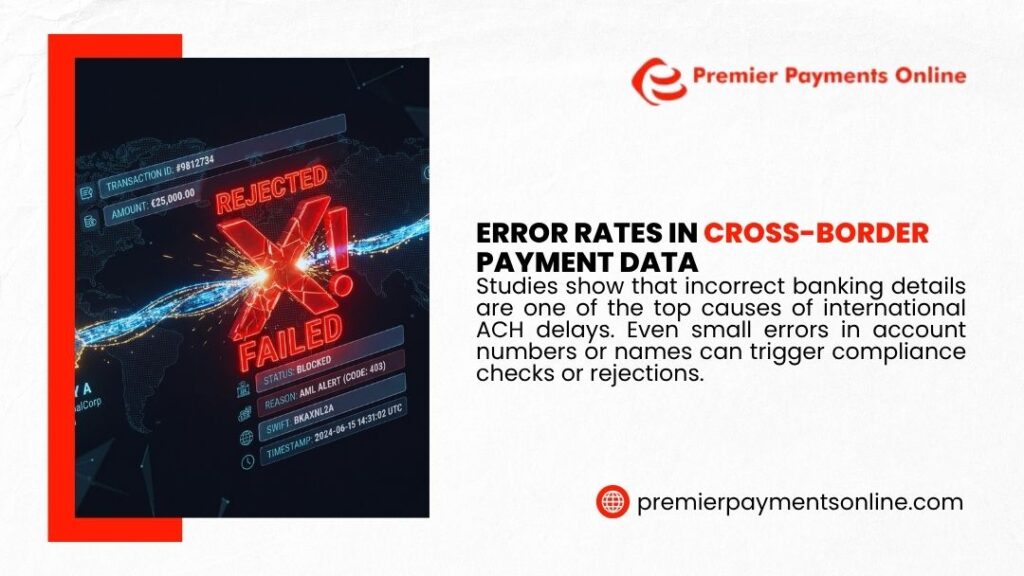
| Error Sensitivity | Incorrect details can delay payments | Demands careful data handling |
| Settlement Delays | Banking partners influence timing | Less control over final delivery |
There’s also the matter of compliance. International ACH transactions require more detailed information than domestic ones. That includes sender and recipient data, which must align with regulatory standards. Even small errors can slow things down.
Still, many businesses accept these limitations because the cost savings and reliability outweigh the drawbacks. It becomes a matter of choosing the right tool for the right situation.
Choosing the Right International ACH Payment Provider
Selecting a provider for international ACH payment processing requires careful consideration. Businesses should look for solutions that support multiple currencies, integrate with existing systems, and provide strong risk management tools.
A reliable provider offers transparent pricing, efficient processing, and compliance support. Integration also matters. Many companies compare options using the concept of payment gateway vs payment processor to better understand how each component functions within the overall payment flow.
Another factor involves routing efficiency. Advanced systems use intelligent payment routing to select the most cost-effective path for transactions, which can reduce fees and improve success rates.
Future of Global ACH and Cross-Border Payments
International ACH payment processing continues to evolve as global commerce expands. The rise of real-time payments has introduced new expectations around speed, but ACH remains relevant due to its cost efficiency.
Financial institutions are exploring ways to connect ACH systems across regions, creating broader global networks. Open banking initiatives also influence how payments move between countries, offering more flexibility and transparency.
The comparison between real-time payments and ACH systems highlights an important shift. While real-time systems provide immediate transfers, ACH maintains its role in recurring and high-volume transactions.
Why International ACH Payment Processing Still Wins for Global Businesses
Despite a few limitations, international ACH payment processing continues to gain traction for one simple reason: it works where consistency matters more than speed. Businesses that rely on predictable cash flow, recurring payments, and controlled costs often find ACH to be the most practical option available.
It doesn’t try to replace every payment method. Instead, it fills a very specific role in the financial ecosystem. When used correctly, it reduces overhead, supports scale, and simplifies cross-border operations without adding unnecessary complexity.
For companies that want more than just a basic processor, the difference often comes down to expertise. That’s where Premier Payments Online stands apart. With a focus on tailored payment solutions, high-risk merchant support, and international processing capabilities, they help businesses navigate the challenges that standard providers often avoid.
If your business is handling cross-border payments and looking for a more efficient setup, it may be time to rethink how those transactions move. A smarter ACH strategy, backed by the right partner, can make a measurable difference.