You run a subscription brand: monthly supplements, a fitness app, a skincare refill club, or a wellness membership. Cards do most of the work, but you may want to consider bank debits because some customers prefer paying from checking, and ACH pricing may work better for higher-value or recurring payments. Actual fees depend on your processor, bank, and payment plan, so compare the full costs before choosing a payment method.
Then you look for an ACH authorization form template and find PDFs that show the blanks without explaining what they mean, what authorization evidence to keep, or how to handle a customer who later says they did not approve a debit.
Here’s a copy-and-adapt template, plus an explanation of its fields and the details to confirm with your processor before using it.
What an ACH authorization form is, in plain English
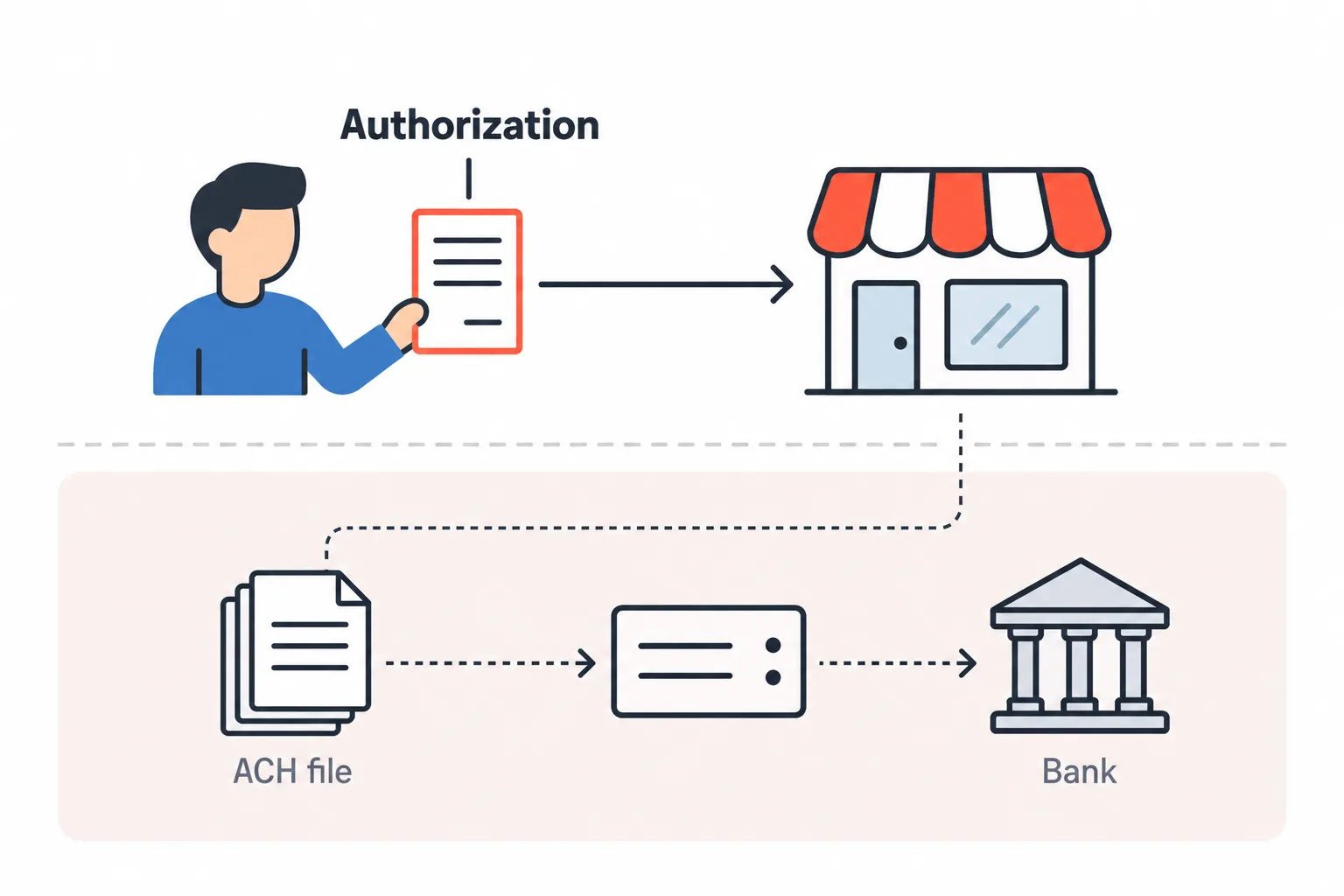
It is written permission from your customer that lets you pull money directly out of their bank account, once or on a repeating schedule. ACH stands for Automated Clearing House, the network U.S. banks use to move money between accounts. Nacha is the organization that writes the rules for that network.
Two things get confused constantly, so let’s separate them:
- The authorization is the customer-facing document. The customer reads it, agrees to it, and keeps a copy.
- The ACH file is the batch of instructions your gateway or processor sends to the bank. Your customer never sees it.
The authorization is important evidence of what the customer agreed to, but it does not, by itself, decide every return or dispute. If a debit is challenged, your processor or ODFI may ask you to provide the authorization and related evidence. Repeated unauthorized or noncompliant debits can put your ACH processing relationship at risk.
The network rules are not the only requirements that may apply. Your processor or ODFI may set additional requirements. Confirm the form and collection flow with them before rollout, especially if your business operates in a regulated category.
The ACH authorization form template (copy, paste, edit)
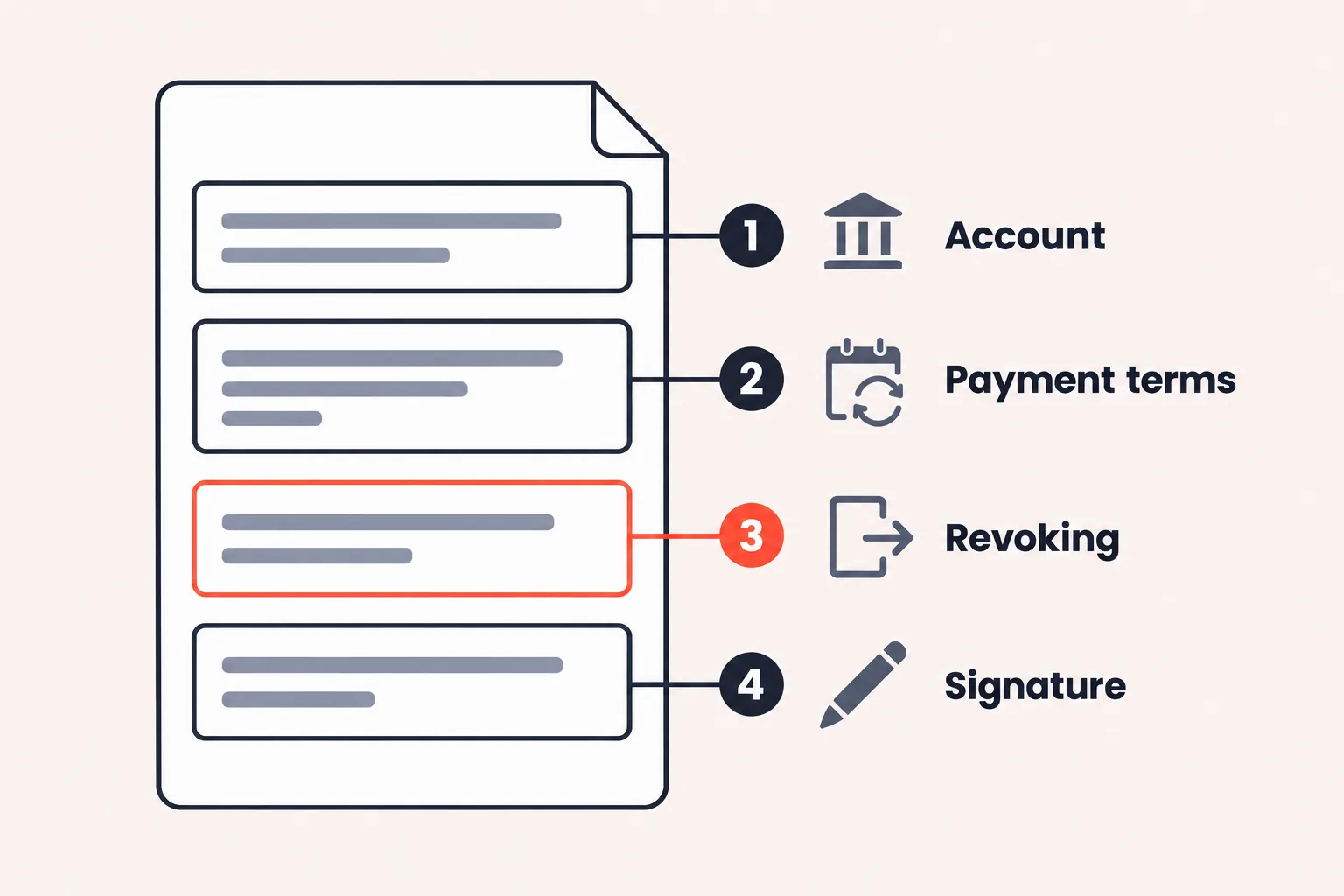
Use this as a starting point for a PDF, e-signature flow, or checkout page. Replace the bracketed fields and confirm the form with your processor or ODFI. This is a general template, not a universal compliance form; requirements can differ by account type, authorization method, and payment plan.
“` ACH DEBIT AUTHORIZATION
I authorize [Company Legal Name] (“Company”) to electronically debit the bank account identified below for the payment terms I select. If needed, company may also credit the account to correct an erroneous debit.
Account holder name (exactly as it appears at the bank): ____________________ Billing address: ____________________________________________________________ Email: ______________________________ Phone: _______________________________
Financial institution name: _________________________________________________ Routing number (9 digits): __________________________________________________ Account number: _____________________________________________________________ Account type: [ ] Checking [ ] Savings Owner: [ ] Personal [ ] Business
PAYMENT TERMS Authorization type: [ ] One-time debit [ ] Recurring debit Amount: $[Amount] (or: variable, as described below) Frequency: [ ] One time [ ] Weekly [ ] Monthly [ ] Other: ________________ First debit date: [Date] End date or number of payments (if applicable): [Details] Business name expected on statement: [Name; confirm the display with your processor]
For variable debits, explain the calculation, schedule, and notice terms here: [Details]. I confirm that I am authorized to approve debits from the account identified above and that the information I provided is accurate.
Revoking authorization
This authorization remains in effect until I cancel it. To revoke it, I may contact [Company] at [Cancellation Email or Mailing Address]. Please submit a request at least [X] business days before the next scheduled debit when possible so it can be processed in time. This requested notice period does not limit any rights I may have to contact my financial institution.
RETURNED PAYMENTS If a debit is returned unpaid, Company may reattempt it only when permitted by applicable rules and the return reason. Any returned-payment fee must be disclosed and may be charged only where permitted by law and the payment agreement.
I acknowledge that I will receive a copy of this authorization.
Signature: ____________________________ Printed name: ______________________ Date: _________________________________ “`
Swapping it for business customers. Name the business as the account holder, include the signer’s title, and confirm the signer is authorized to approve the debit. Consumer and business transactions may follow different rules and protections, so do not assume one version works for both. Confirm the appropriate authorization with your processor or ODFI.
One-time authorization wording
For a single debit with a known amount and date. It may be used for an agreed setup fee, deposit, or invoice payment. Do not use an ACH authorization to collect a different payment from the one the customer approved.
> I authorize \[Company\] to debit my account one time in the amount of $Amount on or after \[Date\] for \[goods or services\].
Keep the single-debit amount and date clear. If you offer recurring payments too, use a separate authorization or an explicit selection with complete terms for each option.
Recurring authorization wording
Fixed amount, fixed schedule, continues until revoked. Use this wording only when the amount and schedule are actually fixed.
> I authorize \[Company\] to debit my account $Amount every \[week/month/quarter\], beginning \[Start Date\], for \[number of payments or until revoked\]. To revoke this authorization, contact \[Company\] at \[contact method\]. If the amount or schedule changes, Company will provide any notice required by the applicable rules and the terms stated here: \[notice details\].
For a changed amount or schedule, follow the notice terms that apply to the transaction and agreement. State how and when customers will receive the notice; a general promise to email them may not satisfy every applicable requirement.
Variable amount authorization wording
For usage-based billing where the number changes every cycle.
> I authorize \[Company\] to debit my account for amounts calculated using \[explain usage, rate, or calculation method\] during each \[billing period\]. Debits will occur \[frequency/date or schedule\]. Company will provide notice of the amount and scheduled debit date according to these terms: \[state the notice period and any agreed reasonable range, if applicable\].
For covered consumer preauthorized transfers, Regulation E generally requires written notice of the amount and date at least 10 days before a varying debit. It also allows notice only when a debit falls outside a specified reasonable range if the customer is told about that range when authorizing the transfers. Confirm how these requirements apply to your payment plan and processor.
A fixed-amount authorization may not describe a debit whose amount changes. State how the amount is calculated and follow the notice terms that apply. Build required notices into your billing workflow.
Field by field: what to include on the form
Account holder details. Collect the account holder’s name and a way to contact them. Make sure the business name receiving authorization is clearly identified.
Bank details. Collect the financial institution, routing number, account number, and account type as needed for your payment flow. Ask the customer’s bank or your processor about account-specific restrictions. Federal Regulation D no longer requires the former six-transfer monthly limit, though a financial institution may set its own account terms.
Transaction details. Include the amount or calculation method, whether the authorization is one-time or recurring, frequency, start date, and any end date or payment limit that applies. Use a recognizable business name and ask your processor how the debit will appear on the customer’s statement; a descriptor can help customers identify the payment.
Consent language. State clearly that the customer authorizes the debit and identify the business that will initiate it.
Revocation language. Explain how the customer can revoke authorization and how to contact your business. Do not imply that a requested notice period limits the customer’s rights with their financial institution.
Signature and date. For online consent, retain evidence that identifies the customer’s action and the terms shown at that time. A timestamp, session details, and the exact authorization text may help document consent; confirm the evidence your processor or ODFI requires.
A copy for the customer. Provide a copy in a form the customer can keep, such as an emailed document or saveable receipt. A copy helps the customer understand the terms and gives both sides a record; it cannot prevent every return or dispute.
Nacha says consumer debit authorizations must be readily identifiable as authorizations and have clear, understandable terms. An originator must provide a copy to the consumer and be able to provide proof when requested. The rules do not prescribe one universal form layout. Review Nacha’s guidance on compliant ACH authorizations.
Paper, online, or over the phone: what changes?
Paper authorization. Collect a signed paper form and retain a readable copy. It may be useful when a customer does not use an online checkout, though processing and storage take more staff time.
Online form or checkout. An electronic authorization may be used when it meets the rules that apply. Retain the authorization terms and evidence of the customer’s consent. Keep versions of changed terms so you can identify what the customer saw when they authorized the debit. Confirm specific evidence requirements with your processor or ODFI.
Phone authorization. Phone authorizations have specific documentation requirements that can depend on the transaction and customer account. Ask your processor whether it requires a recording, written confirmation, or both before you initiate a debit.
An electronic signature or checkbox is not automatically sufficient in every situation. Confirm that your method captures the authorization and evidence required for your transaction type.
You may also ask your processor about account verification methods, such as micro-deposits or an approved account-validation service. Verification can help identify some errors, but it does not replace authorization or guarantee that a payment will not be returned.
How long does an ACH transfer take?
ACH timing depends on submission time, the processor, bank processing windows, weekends, and holidays. Some eligible payments may settle the same day; others settle on a later banking day. Ask your processor for its cutoff and settlement schedule, and avoid promising customers a specific arrival time.
Most “where is my money” questions involve timing expectations. Weekends and bank holidays affect processing, and a late-day submission may move to a later processing window.
Settlement does not mean a debit can never be returned. Return timing and rights depend on the reason, account type, and applicable rules.
- Set fulfillment timing based on your risk, product, and processor guidance; settlement alone does not eliminate return risk.
- Check the return reason before taking action. A retry may be prohibited or inappropriate for some return reasons.
ACH versus cards: cost, approval rates, and running both
Cards and bank debits use different pricing models, which is one reason businesses compare them.
Credit card processing rates are usually a percentage of the sale plus a per-transaction fee. Costs can include interchange, card-brand assessments, and the processor’s markup. The exact pricing depends on the card, processor, and agreement, so a single blended rate may not show every cost.
ACH pricing is often based on a per-item fee, but pricing varies by processor and agreement. Compare the total cost, including monthly, return, and other account fees, rather than assuming ACH is always cheaper.
ACH may be worth comparing for higher-value recurring payments, wholesale or B2B invoices, and payment plans. Cards may suit customers who value immediate authorization, card rewards, or familiar checkout. The right mix depends on customer preference, authorization, settlement timing, and total cost.
Some subscription businesses offer both payment methods and let customers choose. Do not automatically move a declined card payment to ACH unless the customer has separately authorized that debit. PPO describes ACH as part of its ACH and check acceptance program.
When an ACH debit comes back: returns, disputes, and recovery
Returns can happen for different reasons. Review the return code and your processor’s instructions before acting.
Insufficient funds means the account did not have enough available funds when the entry was processed. Review the return reason and payment schedule before deciding whether to submit another debit.
Account closed, or invalid account number means the account information may be incorrect or out of date. Confirm updated details and authorization before submitting another payment.
Unauthorized means the customer or bank reports that the debit was not authorized. A clear authorization, recognizable business information, and accessible support can help reduce confusion, but none can prevent every claim.
- Your processor or ODFI may monitor return rates and require corrective action. Ask what thresholds and reporting apply to your account.
- Nacha limits reinitiations. Do not reinitiate a debit returned as unauthorized unless you obtain a new authorization; follow the rules and processor instructions for other return reasons. See Nacha’s ACH risk and reinitiation guidance.
- Consumer rights and return timeframes depend on the transaction and applicable law. Keep the authorization and related records, but do not treat them as a guarantee that a return will be denied.
For ordinary payment failures, use clear customer notices and an appropriate recovery process rather than relying on repeated automatic retries. PPO’s online bill payment options include one-time, future-dated, installment, and recurring payments by ACH, subject to the service terms.
How long to keep the signed authorization
Keep the authorization and related evidence for the period required by the rules and your processor or ODFI. Retention requirements can differ by authorization type; confirm the applicable period instead of applying one period to every ACH debit. Keep records organized so you can retrieve them promptly if requested.
A usable record system should let authorized staff retrieve a customer’s authorization without exposing full account details unnecessarily. A folder of PDFs with unclear filenames is difficult to manage.
For storage hygiene:
- Encrypt stored account numbers.
- Mask them in your admin panel so support staff see only the last four.
- Restrict who can view the full number, and log who looked.
Handle cancellations promptly. Log the revocation date and stop future debits as required by the authorization and applicable rules. For consumer preauthorized transfers, customers may also contact their financial institution to stop payment; the form should not imply they must rely only on your internal cancellation process.
Five mistakes that turn an authorization into a dispute
1\. A statement descriptor nobody recognizes. A customer may not connect an unfamiliar business name with a purchase. Fix: explain the business name that will appear and provide a working support contact; confirm the actual statement display with your processor.
2\. Fixed-amount wording on a plan whose price later changed. The debit may no longer match the authorization. Fix: state how amount changes are calculated and follow the notice requirements that apply.
3\. No copy sent to the customer. The customer may not remember the agreed terms. Fix: provide a copy in a format they can keep and retain your own evidence.
4\. Wrong account type or wrong signer. Incorrect account information or an unauthorized business signer can delay or challenge a payment. Fix: collect accurate account details and confirm business signatory authority where relevant.
5\. A free trial that rolls into a bank debit without a clear reminder. A customer may be surprised by the first charge. Fix: make the trial-to-paid terms, first debit amount and timing, and cancellation method clear during signup; consider a reminder where appropriate.
If you are in a high-risk or heavily regulated category
Supplement brands, telehealth and weight-loss programs, CBD, and trial-to-paid offers may receive additional underwriting review depending on the processor and acquiring bank. Do not assume every business in a category has the same requirements. Review your checkout, authorization language, and cancellation policy with your processor.
Review whether trial-conversion terms, refund policy, cancellation steps, and payment amounts are easy to understand and consistent across your website and authorization. Your processor or ODFI may ask how the billing flow works; resolve inconsistencies before submitting an application.
Clear billing terms and reliable cancellation handling can help customers understand what they authorized. They do not guarantee approval or prevent all returns.
Frequently asked questions
Is an ACH authorization form legally binding?
Do I need a handwritten signature, or is a checkbox enough?
Can I email the form and accept a scan or photo back?
How long does an ACH transfer take once the form is signed?
Can a customer cancel an ACH authorization?
What happens if the customer’s bank says the debit was unauthorized?
Can one form cover both one-time and recurring charges?
Do business customers need different wording than consumers?
Getting set up to accept ACH alongside cards
In short: clearly state the amount or calculation method, frequency, and who is authorized to debit the account. Give customers a copy, retain the evidence securely, follow the applicable notice and revocation requirements, and check the return reason before retrying a payment.
If you are working out how ACH should fit alongside card processing, how to structure recurring billing, or what your return trends mean, contact us to discuss your payment setup. PPO’s website describes the company as a registered ISO/MSP and agent working with multiple acquirers and processing partners.
No provider can promise an approval. The acquiring bank makes its own underwriting decisions. A conversation can help you understand what questions to take to your processor and which payment options may fit your business.