When your processor asks you to complete a PCI SAQ, it can be hard to tell which version fits. The names read like alphabet soup, and choosing without checking your payment flow can mean answering requirements that do not fit, or attesting to something that is not true.
This guide helps you identify a likely SAQ based on how your business accepts and handles payment card data. Your acquirer or payment brand must confirm which validation applies to your environment.
Quick answer: Which PCI SAQ might fit my business?
The likely SAQ depends on where payment data goes, which systems or people can access it, whether you accept cards online, by phone, or in person, and whether you use a validated payment solution. A hosted checkout may point to SAQ A; a merchant-controlled payment page may point to SAQ A-EP; standalone terminals, virtual terminals, payment applications, P2PE, and SPoC each have their own eligibility criteria. These are starting points, not a final determination.
What a PCI SAQ is, and who confirms which one you need
SAQ means Self-Assessment Questionnaire. PCI SSC describes SAQs as validation tools for merchants and service providers that are eligible to self-assess. Each questionnaire applies to a defined environment; it is not a general checklist that every merchant can choose. See PCI SSC’s merchant resources for its overview of SAQs and PCI DSS.
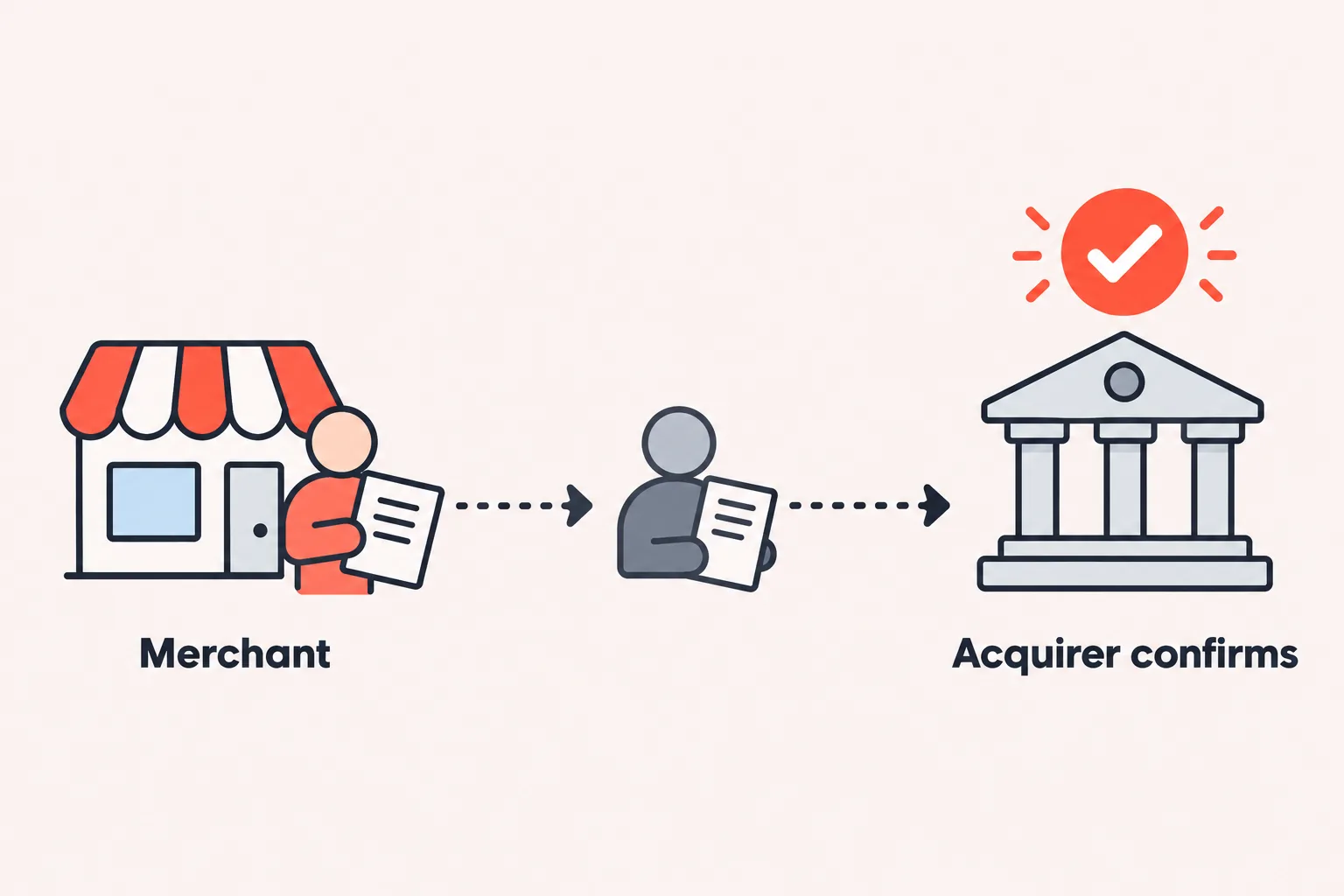
PCI DSS and the payment brands establish the security framework. The entity that receives your compliance validation, usually your acquirer or a payment brand, confirms whether you must submit an SAQ and which one applies. An ISO may help pass along the request, but it may not be the entity making the final decision.
Your payment provider may charge a non-compliance fee under its own terms if you do not submit required validation. The amount and policy vary; a monthly fee is not an automatic PCI DSS charge. Review your notice and agreement. PPO also has a guide to PCI DSS non-compliance charges.
An SAQ and merchant level are related to validation, but they answer different questions. Transaction volume may affect the validation path or reporting required by a payment brand. Your environment and the SAQ eligibility criteria determine which questionnaire may fit. Some merchants may need a Report on Compliance (ROC) rather than an SAQ, so do not assume that a particular merchant level alone determines the answer.
The Payment-Flow Questions That Point to Your SAQ
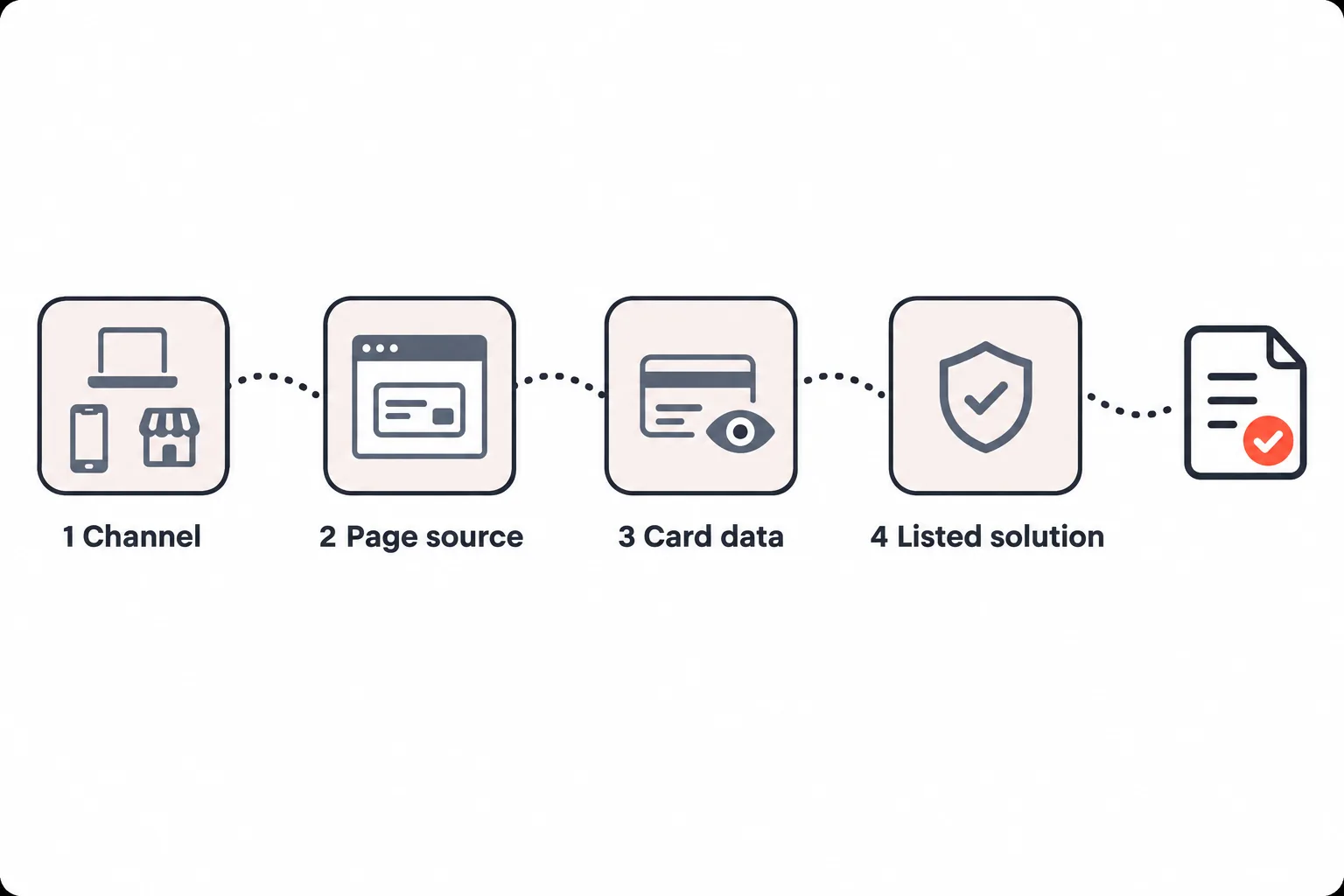
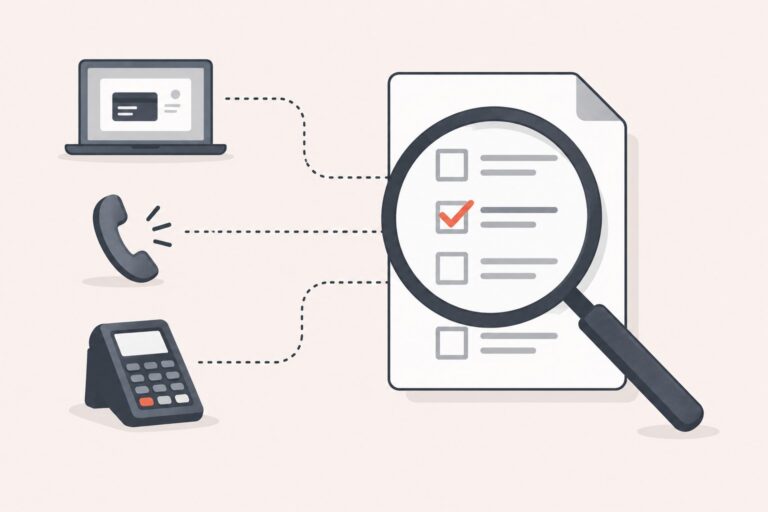
Start by mapping how card data enters, moves through, and leaves your business. Then answer:
1. Which payment channels do you use: e-commerce, phone/mail order, or in person? 2. Does the payment page come directly from your provider, appear inside your website, or use elements your website creates? 3. Do your systems, staff, or service providers receive, process, transmit, or electronically store card numbers? 4. Are you using a specific PCI SSC-listed solution, such as validated P2PE or SPoC?
Storing card data electronically can make SAQ D relevant, but a momentary interaction with a card number does not, by itself, tell you which SAQ applies. The full data flow and every eligibility criterion matter.
Quick comparison: payment flow and likely SAQ
Use this table to narrow the possibilities. It does not replace the full eligibility criteria or your acquirer’s instructions.
| Payment setup | SAQ that may fit | Key point to confirm |
|---|---|---|
| Online or phone/mail order payments fully outsourced to a PCI DSS-compliant provider | SAQ A | Confirm all account-data functions are outsourced and check current e-commerce webpage criteria. |
| Merchant-controlled payment page sends data directly to a provider | SAQ A-EP may fit | Confirm which page elements originate from your website and that you meet every A-EP criterion. |
| Standalone dial-out terminal or imprint machine | SAQ B may fit | The environment must meet B’s permitted device and channel criteria, including no electronic account-data storage. |
| Standalone PCI-approved IP-connected terminal | SAQ B-IP may fit | Confirm the device is an eligible PTS-approved POI device and is used in the qualifying standalone environment. |
| Staff manually key one transaction at a time into a provider-hosted virtual terminal | SAQ C-VT may fit | The computer must meet isolation and other C-VT requirements; no other electronic account-data channels can be present. |
| Internet-connected payment application system | SAQ C may fit | Confirm the application, location, network, and data-storage conditions in the current criteria. |
| All card-present processing uses a validated PCI-listed solution | SAQ P2PE or SAQ SPoC may fit | The exact solution and implementation must be listed and used according to its instructions. |
| Merchant electronically stores account data or does not meet another eligible merchant SAQ | SAQ D for Merchants may apply | First confirm you are eligible to self-assess rather than required to complete a ROC. |
SAQ Types, Matched to How You Take Payments
SAQ A: Fully Outsourced Card-Not-Present Payments
SAQ A is for eligible e-commerce and mail/telephone-order merchants that outsource all account-data functions to PCI DSS-compliant third parties and do not electronically store, process, or transmit account data in their own systems. A hosted payment page or provider-hosted payment form may fit, but the checkout design matters.
For e-commerce pages that embed a provider’s payment form, such as an iframe, the current SAQ A eligibility criteria require the merchant to confirm that the page is not susceptible to script attacks that could affect the e-commerce system. PCI SSC explains ways to meet this criterion in its SAQ A script-attack FAQ. This criterion applies to embedded payment forms; the FAQ distinguishes them from redirect and fully outsourced payment-link flows.
Having an in-person payment channel does not automatically disqualify your online channel from SAQ A. It may mean you need to validate the in-person environment separately or follow a combined approach specified by your acquirer or payment brand.
SAQ A-EP: Your e-commerce site controls part of the payment page
SAQ A-EP may fit eligible e-commerce merchants whose website creates some or all of the payment-page elements, while payment data is sent to a PCI DSS-compliant third party and is not stored by the merchant. Direct-post implementations are a common example. A provider-hosted iframe or redirect is not automatically A-EP; the page’s data flow and the current eligibility criteria matter.
A custom checkout can bring more of your website into PCI scope. Before classifying it, ask your developer and payment provider which page elements originate from your site, where the card data goes, and which systems can affect the payment page.
SAQ B and B-IP: Standalone Terminals
SAQ B is for eligible merchants using only imprint machines or standalone dial-out terminals, with no electronic account-data storage. SAQ B-IP is for eligible merchants using standalone, PCI-approved PTS POI devices connected by IP, also with no electronic account-data storage.
A terminal connected to a broader point-of-sale network or used alongside other payment channels may not meet these criteria. Confirm the device type, network setup, and other channels with your acquirer.
SAQ C and C-VT: Payment applications and virtual terminals
SAQ C-VT is for eligible merchants that manually enter one transaction at a time into a third-party-hosted virtual terminal using a browser on an internet-connected computer. The computer must be isolated from other systems, and the merchant must not store account data electronically or receive or transmit it through another electronic channel.
SAQ C may fit eligible merchants using an internet-connected payment application system in a qualifying environment. Do not assume that any POS or payment software automatically fits SAQ C; the location, network, application, storage, and channel criteria all matter.
Phone-order businesses that key card details into a virtual terminal may want to check C-VT, but the voice call itself does not decide the SAQ. Confirm the computer and payment setup against every criterion.
SAQ P2PE and SPoC: Validated solutions for card-present payments
SAQ P2PE may fit merchants that process card-present payments only through a PCI SSC-listed point-to-point encryption solution and follow that solution’s instruction manual. An encrypting terminal alone does not make a solution validated.
SAQ SPoC is for eligible attended PIN-entry transactions using a secure card reader and a commercial phone or tablet as part of a validated, PCI SSC-listed SPoC solution. A regular phone or tablet payment app is not automatically a SPoC solution.
Both options depend on the exact validated solution and how you implement it. Check the PCI SSC listing and confirm eligibility with your acquirer.
SAQ D: When no other eligible merchant SAQ fits
SAQ D for Merchants may apply if you electronically store account data or do not meet the eligibility criteria for another merchant SAQ. SAQ D is also a demanding questionnaire, so do not choose it simply because it seems safer. If your organization is not eligible to self-assess, your acquirer or payment brand may require a different assessment, such as a ROC. There is also a separate SAQ D for eligible service providers.
Recurring billing alone does not automatically mean SAQ D. A provider-held token may reduce the merchant’s exposure to the full card number, but tokenization does not determine SAQ eligibility by itself. Check the complete payment flow, connected systems, and provider responsibilities.
Where merchants get this wrong
Tokens can reduce exposure, but they do not automatically remove every connected system from PCI scope. Confirm whether your token can reveal or be exchanged for account data, and what systems are involved in creating or using it.
Card numbers can end up in spreadsheets, CRM notes, support tickets, emails, or call recordings. If your business receives or electronically stores full card numbers through those channels, include those processes in your scope review.
Checkout scripts need a closer look. Scripts that can affect a payment page may create security and PCI concerns, but not every analytics tag has the same effect. For embedded payment forms, check the specific SAQ A script criterion; also review the broader security requirements for your page. PPO’s risk and fraud management describes its related support.
Do not assume every merchant ID needs a separate SAQ, or that one SAQ automatically covers every channel. Map each distinct payment environment and ask your acquirer how it wants the validation reported.
How to Confirm Your SAQ in Three Steps
1. Map every path card data takes through your business. Include people, paper, calls, websites, terminals, service providers, and connected systems. 2. Check what your checkout and payment setup does now. A new plugin, iframe, redirect, terminal, or CRM process may change the environment. 3. Confirm the required validation with your acquirer or payment brand. Your ISO may help route the question, but confirm with the entity that receives your PCI validation. PPO’s PCI compliance test resource can help you review the basics before that conversation.
What happens after you identify the likely SAQ
Complete the applicable SAQ and its Attestation of Compliance (AOC), then submit them as your acquirer or payment brand directs. An AOC is the formal attestation associated with the assessment; it does not replace meeting the underlying requirements. PPO’s PCI assessment and attestation guide explains the documents and process.
PCI DSS v4.x SAQ A includes ASV external vulnerability scans for e-commerce webpages, even when payment processing is outsourced. PCI SSC’s current SAQ A scanning FAQ covers webpages that redirect to a provider or embed its payment form. Other scanning and validation requirements depend on the SAQ and your environment; confirm them with your compliance-accepting entity.
Revalidate on the schedule your acquirer or payment brand requires, commonly annually, and reassess when your payment flow changes. Do not assume a new checkout, channel, or integration can wait until the next annual submission.
FAQs
Related readingSecure Payment Gateway: Protect Your Business FastRead the guide →Frequently asked questions
Can I fill out SAQ D just to be safe?
Does using a payment gateway make me PCI compliant automatically?
Do I need more than one SAQ if I sell online and in person?
Who decides which SAQ I submit?
Does SAQ A require ASV scans?
Can I use SAQ A if my checkout uses an iframe?
Does recurring billing change my SAQ?
Not sure which one fits? Let’s look at your payment flow
The right starting point is understanding what your checkout, terminals, staff, and payment providers actually do. Premier Payments Online can discuss your payment setup and help you prepare questions about PCI compliance. Your acquirer or payment brand confirms the required SAQ and validation path. Contact us to talk through your payment-processing needs.