You run a supplement brand or subscription business, revenue is steady, and an offer lands: $50,000 quickly, a “1.32 factor rate,” and limited paperwork. Next to the card-processing rates you are used to seeing, 1.32 can look small.
But a merchant cash advance (MCA) factor rate is not an annual interest rate. This guide shows how to calculate the stated payback, account for fees, and compare the offer with your cash flow before signing.
What a merchant cash advance factor rate actually is
A factor rate is a multiplier used to calculate the stated total payback on an advance.
Advance amount × factor rate = stated total payback
That is the basic pricing structure. Interest on a conventional loan is generally calculated against an outstanding balance, while an MCA factor rate sets a fixed payback amount at the start. The agreement controls how collections work and whether any adjustment or early-payoff terms apply.
MCAs are commonly described as purchases of future receivables or sales, but the agreement and applicable law determine how a specific transaction is treated. The CFPB describes MCAs as products that purport to be structured as purchases of future income.
Do not assume that a purchase structure means there are no required disclosures. Requirements vary by product and jurisdiction. For example, New York law requires an estimated APR disclosure for certain covered factoring transactions; that state-specific rule does not establish the requirements everywhere. See New York’s factoring transaction disclosure law.
How to calculate the total cost, step by step
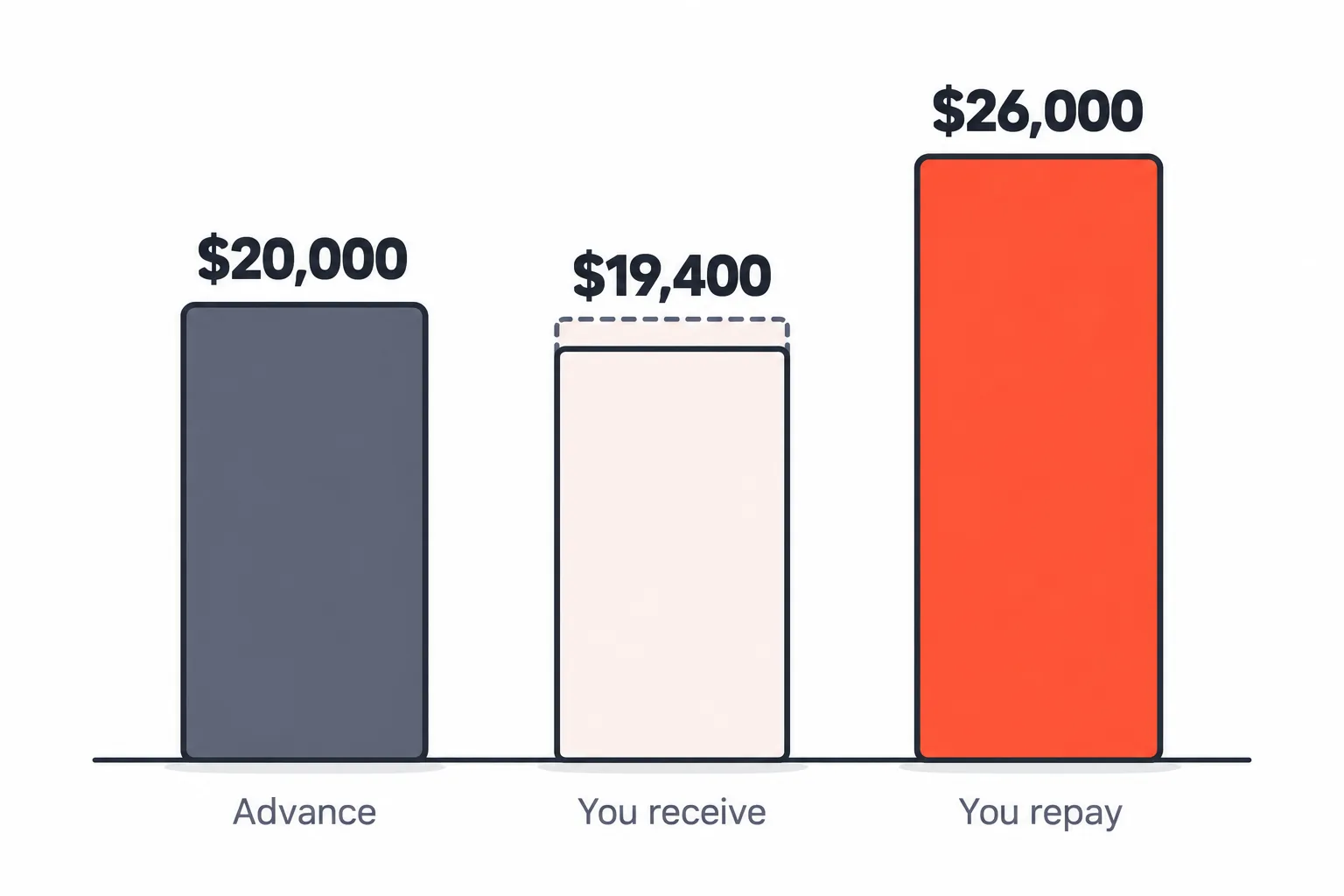
The figures below are examples to show the arithmetic, not typical offer terms.
A $20,000 advance at a 1.3 factor rate:
1. Stated total payback: $20,000 × 1.3 = $26,000 2. Factor-rate cost before fees: $26,000 − $20,000 = $6,000 3. Factor-rate cost as a share of the gross advance: $6,000 ÷ $20,000 = 30%
At a 1.45 factor rate, the stated payback would be $29,000, and the factor-rate cost before fees would be $9,000. Compared with 1.3, that is $3,000 more in stated cost on the same gross advance.
Some offers also deduct origination, underwriting, ACH, or other fees from the funding. For example, if a hypothetical $20,000 advance has a 3% fee deducted, the business receives $19,400 but may still owe the stated $26,000. The total cash cost measured against net proceeds would then be $6,600, not $6,000. Check the agreement for the actual fee treatment.
Use these two calculations when comparing offers:
- Net proceeds = gross advance − fees deducted at funding
- Cash cost against net proceeds = stated total payback − net proceeds
Two numbers to get in writing before anything else: the total payback in dollars and every fee deducted at funding. Also confirm the net amount that will actually reach your business account.
Factor rate vs APR: how to compare the real cost
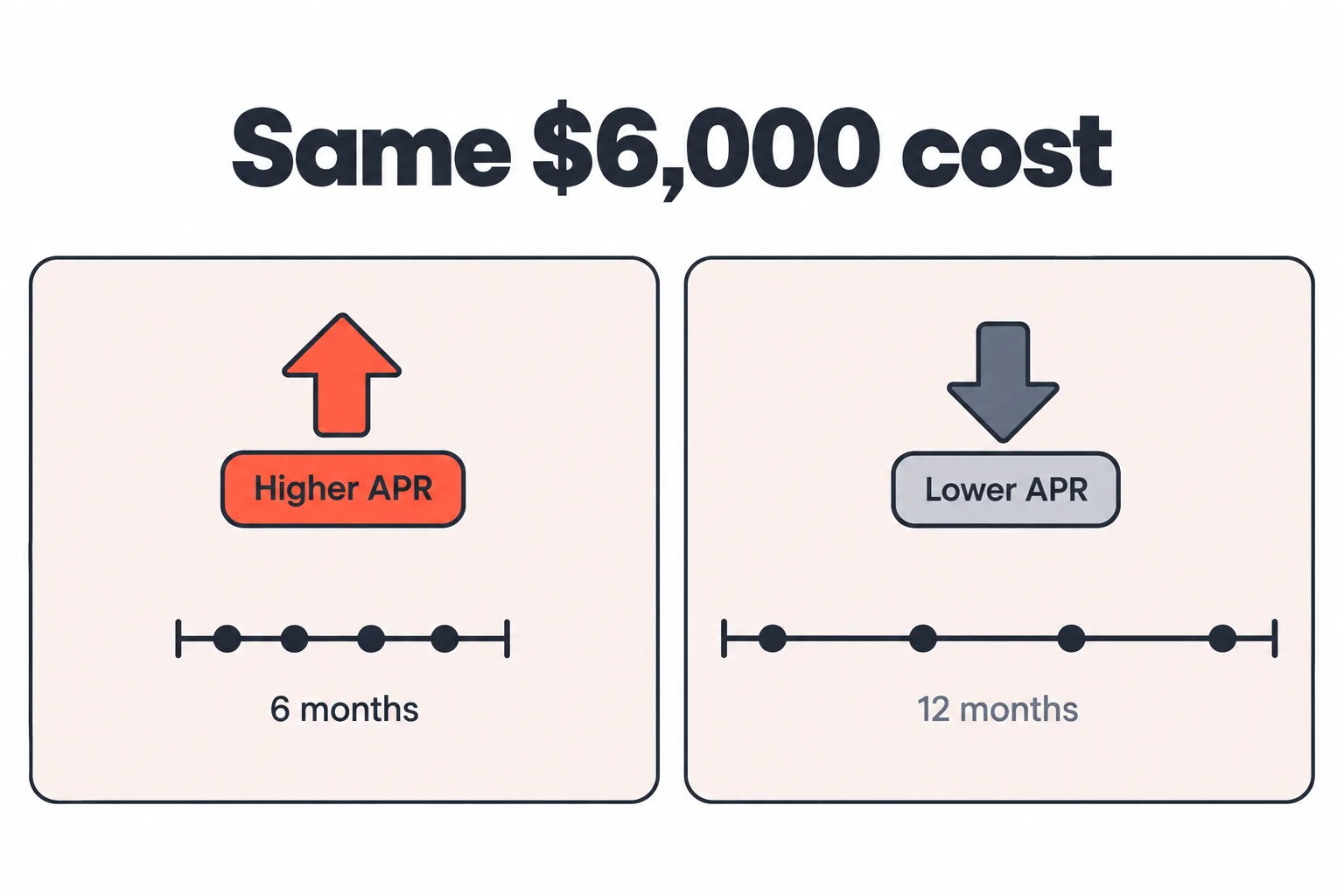
The common misread is treating the decimal as an annual percentage.
A 1.4 factor rate is not 40% a year.
It is a 40% flat factor-rate cost before fees, and how expensive the advance is over time depends on the repayment schedule.
A simple calculation that divides the flat cost by the advance and annualizes it is not necessarily an APR. A reliable annualized estimate needs the net proceeds received, fees, and the amount and timing of each payment. With daily, weekly, or sales-based collections, the actual repayment pace can change, so show the assumptions and treat the result as an estimate.
For a useful comparison, ask for the full payment schedule and net proceeds, then calculate the annualized cost from those dated cash flows. The Federal Reserve notes that small-business financing may be quoted using factor rates rather than the APR disclosures familiar from consumer credit.
Do not compare a factor rate directly with a bank loan’s APR. Compare the amount received, fees, total payback, payment frequency, expected term, and the cash flow left after each payment. A bank term loan, SBA-backed product, or business line of credit may be worth comparing if you qualify.
What affects an MCA factor rate?
There is no single factor-rate range that applies to every funder or merchant. Published business-finance guides describe broad ranges, but individual offers vary by funder, product, business profile, fees, and repayment terms. Treat any range as a rough market reference, not a quote or benchmark. A published MCA guide covering factor rates and holdbacks provides one comparison point; verify its assumptions against the offer in front of you.
What underwriters may look at
- Recent bank statements: deposit consistency, account balances, and returned payments
- Time in business and the business’s industry
- Card-processing volume and how stable it has been
- Refunds, disputes, and chargebacks
- Existing advances or other scheduled debits
- Business and personal credit information, where the funder considers it
The factors and their weight differ by funder. Ask which details affect the quote and whether a change in payment schedule or fees changes the total cost.
Why high-risk merchants may receive different offers
A funder may consider how stable the revenue is and whether the deposits used for repayment could be interrupted. A processor hold, account closure, or reserve change could affect the cash flow an advance depends on, but none of these factors automatically sets an MCA price.
Subscription, nutraceutical, telehealth, CBD, vape, and other businesses may have different underwriting requirements depending on the funder and the merchant’s profile. Card-network monitoring and MCA pricing are separate processes; do not assume that a category alone means a higher factor rate. PPO describes payment solutions for harder-to-place markets on its High-Risk Merchants page.
Before applying, review your processing history, recurring-billing performance, refunds, and disputes. PPO’s Risk & Fraud Management services are relevant to those payment-processing issues, but they do not set or approve an MCA offer.
How repayment hits your cash flow
Repayment methods vary by agreement. Common structures include:
- A percentage of card sales (holdback): the funder collects an agreed share of eligible sales.
- Fixed daily or weekly bank debits: a set amount is withdrawn on a schedule, even if sales fluctuate, unless the agreement provides an adjustment.
- A lockbox or controlled account: deposits are routed through an account under the arrangement described in the contract.
The percentage taken in a card split is the holdback, and it is a different number from the factor rate. Some published guides cite holdbacks in a broad range such as 5% to 20%, but the contract may differ; verify the percentage, calculation base, and any fees in your offer. The factor rate sets the stated total payback. The holdback affects collection pace and the amount of each day’s sales you retain.
Fixed debits can put pressure on seasonal or subscription businesses when sales dip. A percentage-based collection may move with sales, but the contract may also include minimums, reconciliation steps, or other conditions. Read the actual terms.
Early payoff may not reduce the stated payback. Ask for a written payoff quote and confirm whether the agreement offers an early-payoff discount.
For subscription merchants, one trap compounds. Failed rebills and chargebacks cut your deposits. On a card split, that stretches the term out while the amount owed sits unchanged. On a fixed debit, it drains a thinner account at the same pace as before. The impact depends on the collection terms and the timing of your sales.
If you use recurring billing, review your retry and account-updater setup before taking on fixed withdrawals. PPO’s recurring payment processing guide covers payment operations that can affect recurring revenue.
MCA contract terms to review before signing
| Clause | What to check |
|---|---|
| Processor restrictions | Check whether the agreement limits changing processors, redirecting deposits, or adding another merchant account. Ask your processor before changing the setup. |
| Stacking or cross-default clauses | Confirm whether additional financing could trigger a default or change the amount due. |
| Personal guarantees | Identify who signs personally and what events may trigger liability. |
| Reconciliation | If repayment is tied to a share of actual receivables, ask how reconciliation works, how to request it, what records are needed, and when a decision is due. Do not assume the clause automatically adjusts payments. |
| Confession of judgment | This may allow a funder to seek a judgment based on prior consent where enforceable. Its availability and procedure vary by jurisdiction; ask a business attorney to review the clause. |
| Renewal or refinancing | Compare the existing payoff, new advance, fees, and new total payback to check whether previously repaid amounts are being rolled into a new deal. |
| UCC filings or security interests | Check whether the agreement authorizes a lien or filing against business assets and ask an attorney what it means for your business. |
Have a business attorney read the agreement. A short review before signing may help you understand the obligations; the contract and applicable law control.
Before you take the advance: fix the leaks first
Plenty of merchants reach for an advance to cover a cash gap their payment setup created. Check these first:
- Failed recurring charges. Review retry timing, card updater options, and payment-failure notices. Better recovery may improve collected revenue, but results vary.
- Dispute leakage. Check whether customers recognize the billing descriptor, whether alerts are available, and whether you are responding to disputes with supporting records.
- Reserve terms. Know whether your current account has a reserve, how much is held, and what release terms apply.
- Approval rates. Review declines and routing with your processor. A second merchant account may offer redundancy only where the acquirer and any financing agreement allow it; it does not guarantee higher approvals.
PPO’s ACH–Check Acceptance Program may be relevant if you are also comparing payment methods for your business. Sometimes the advance is still the right call: time-sensitive inventory, an ad window closing. The goal is to make it a decision rather than a reflex.
Questions to ask any MCA funder before you sign
1. What is the total payback amount in dollars? 2. What fees come out at funding, and what net amount lands in my account? 3. What is the holdback percentage or fixed debit, and how is it collected? 4. What is the expected repayment term, and how is it estimated? 5. What happens if my volume drops, and how do I request reconciliation? 6. Is there any discount for early payoff? Can I get a written payoff quote? 7. Does this agreement restrict changing or adding payment processors? 8. What happens if I take additional financing? 9. Does the agreement include a personal guarantee, a UCC filing, or a confession-of-judgment clause? 10. What is the estimated annualized cost using the actual net proceeds, fees, and payment schedule? What assumptions are used?
Frequently asked questions
What is a good factor rate for a merchant cash advance?
Is a factor rate the same as an interest rate?
How do I estimate the APR on an MCA?
Does paying off an advance early save money?
What is a holdback rate?
Can I switch payment processors during an active advance?
Do chargebacks affect a merchant cash advance?
Does “no collateral” mean there is no personal guarantee or lien?
Getting a clearer read on your numbers
Premier Payments Online does not fund merchant cash advances. PPO provides card and ACH processing services, including for harder-to-place markets, so its role is to discuss payment-processing issues such as recurring billing, disputes, reserves, and processor restrictions, not to recommend financing or provide legal advice.
If you want to discuss how an offer could interact with your merchant account, contact PPO. We can discuss the processing side and explain what to confirm with your funder, processor, or attorney.
No guarantees here on approvals, outcomes, or savings. The specifics always depend on your business and your acquirer.
Written by Irini Tomei, Principal CEO at Premier Payments Online, a registered ISO/MSP and agent working with multiple acquirers and processing partners. PPO’s About page lists 15+ years in the payment industry and risk management.