If you sell merchant accounts, your income is not a paycheck. You may receive an ongoing share of eligible processing revenue from accounts you bring to an ISO or processor. The agreement defines what revenue counts, which costs come out, how often you are paid, and what happens when an account closes.
This guide is for independent agents, small ISOs, brokers, CPAs, and commercial resellers evaluating merchant-services residuals, including programs that serve higher-risk businesses. The examples are hypothetical; actual calculations depend on the agreement, processor, sponsoring acquirer, account activity, and any adjustments.
Merchant Services Residuals, in Plain English
A merchant-services residual is a recurring payment to an agent or ISO tied to eligible revenue from a merchant account. The agreement determines how the residual is calculated, when it is paid, and whether it continues after the agent relationship ends.
Residuals are not guaranteed income. They can change when processing volume, pricing, account status, costs, or contract terms change. A merchant closing, switching providers, or processing less volume can reduce or end the payment, depending on the agreement.
Some agreements also include an upfront bonus or signing payment, sometimes with a clawback if an account closes within a stated period. Other arrangements emphasize ongoing residuals. These terms vary, so compare the amount paid up front with the future residual rights and obligations in writing.
How Processing Revenue Becomes an Agent Residual
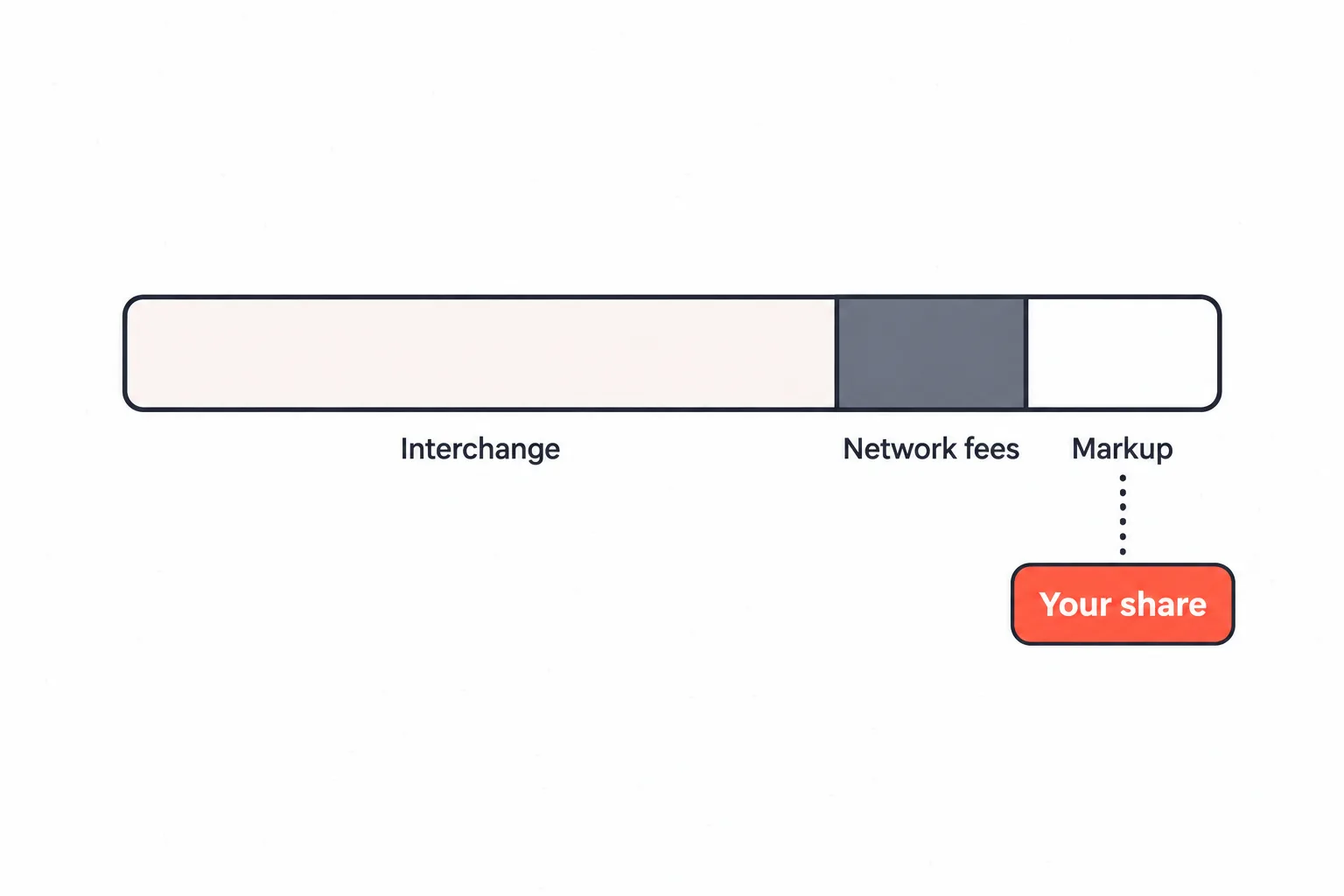
A merchant’s card-processing costs can include several components:
1. Interchange, which card networks set and which generally flows to the cardholder’s issuing bank through the payment system. 2. Card-network assessments and other network fees. 3. Acquirer, processor, gateway, and ISO charges or markups.
This is a simplified view. Merchants generally pay a merchant discount or other agreed fees to their financial institution or provider; they do not usually pay interchange as a separate bill. See Visa’s explanation of merchant fees and interchange.
An agent’s residual is not automatically the entire markup. The agreement may define an eligible revenue base and specify which processing costs, processor or ISO shares, per-item charges, gateway revenue, ACH revenue, or other adjustments are included. With interchange-plus pricing, some markup items may be easier to identify. Tiered or bundled pricing may make the calculation harder to trace, so ask for the definitions used in your residual report.
ACH may create a separate revenue line when the agent agreement includes it. Its pricing could be per item, percentage-based, or another arrangement; check the schedule instead of assuming one model.
One warning: a high rate charged to the merchant does not automatically mean a fat residual. If your wholesale cost (your buy rate) is also high, the account may be less competitive and more likely to shop for another provider.
How a Residual Is Calculated, Step by Step
There is no single calculation sequence that applies to every agent agreement. Use these steps to understand the report, then confirm the exact order of operations in your contract:
1. Identify the account’s processing volume and each revenue item that the agreement includes. 2. Check which costs are subtracted before the residual base is calculated, including any processor, acquirer, network, gateway, or per-item costs defined in the agreement. 3. Apply the agent’s split to the base specified in the agreement. 4. Review any agent-level deductions, adjustments, minimums, or holdbacks. The agreement determines whether these apply before or after the split.
A simplified illustration is: eligible residual base × agent split, adjusted for any contract-defined deductions. Your agreement may calculate the base or deductions differently.
The split percentage matters only after you know what revenue it applies to and what costs are removed before your share is calculated.
Gross vs. Net Residual Splits: What the Percentage Applies To
“Gross” and “net” are not used identically in every agent agreement. Ask the ISO to define the base in writing: which revenue is included, which costs are deducted, and whether expenses or losses can be charged to your share.
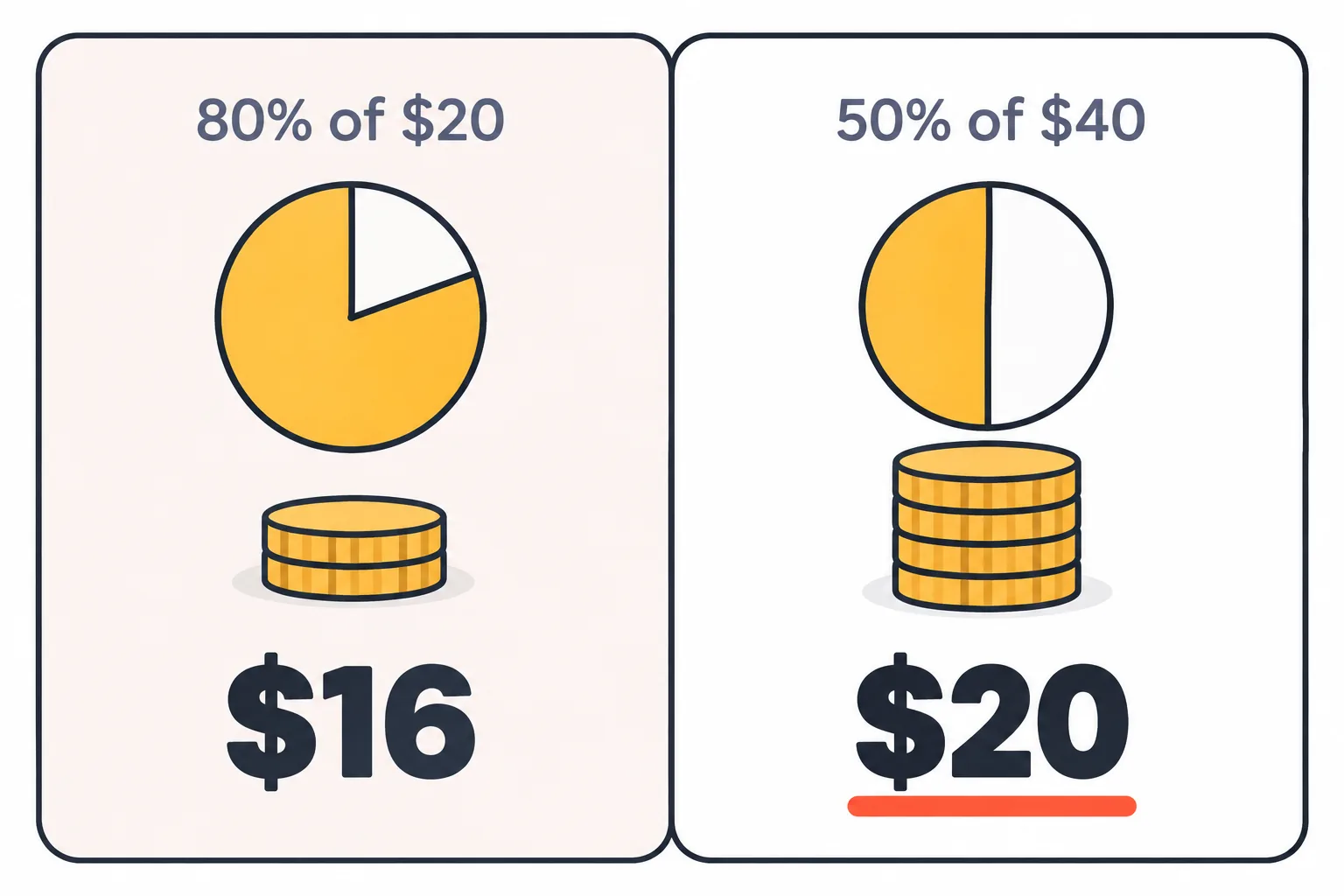
For illustration only, an 80% share of a $20 eligible base is $16; a 50% share of a $40 eligible base is $20. The percentages alone do not show which offer pays more because the calculation bases differ. Request a side-by-side estimate using the same hypothetical merchant profile and each program’s written cost schedule.
Before you sign, get the buy rate or cost schedule, the definition of eligible residual revenue, the full deductions list, and a sample anonymized residual report. A screenshot of someone’s best month does not explain the calculation.
A Worked Example
Illustrative only, and not a promise of earnings.
Assume a merchant processes $50,000 in card volume during a month, and the agreement produces an eligible markup amount of 50 basis points (0.50%) on that volume. That equals $250 before any other contract-defined costs or adjustments. At a 60% agent split of that $250 base, the illustrative share is $150 before any agent-level deductions.
| Illustrative calculation | Amount |
|---|---|
| Monthly card volume | $50,000 |
| Eligible markup assumption | 0.50% |
| Illustrative base before other costs or adjustments | $250 |
| Illustrative agent split | 60% |
| Illustrative share before agent-level adjustments | $150 |
Twenty-five accounts with the same assumptions would total $3,750 before differences in volume, costs, attrition, fees, and contract adjustments. This is arithmetic for illustration, not a forecast or typical earnings claim.
A real report may include per-transaction revenue, monthly fees, ACH revenue, processing costs, reserves, chargeback-related amounts, or other adjustments if the agreement includes them. A subscription merchant with many low-ticket payments may produce a different revenue mix from a merchant with fewer high-ticket sales, even at similar monthly volume.
What Gets Deducted Before You Get Paid
Possible costs or adjustments vary by program and may include:
- Chargeback, retrieval, or dispute-related amounts if the agreement allocates them to the agent or residual base
- Merchant losses or unrecovered debit balances when the agreement makes the agent responsible for a defined share
- PCI or other compliance fees if they are included in the program’s cost schedule
- Network fee changes, monthly minimums, or account-level charges where the agreement says they affect residuals
- Portfolio minimums, thresholds, or holdbacks that affect when a payout is issued
Reconcile at least one account line by line every month, especially early on, and ask questions whenever a number moves. Request the report definitions and written explanation of any new fee or adjustment.
When Residual Statements Are Calculated and Paid
Many programs calculate residuals monthly, but the close date, reporting period, minimum payout threshold, and payment date depend on the agreement and processor schedule. Your first payment may not arrive until after onboarding, the first processing period, month-end reporting, and the payout run. Ask for the expected first-payment window in writing.
Payment may arrive by ACH or another method named in the agreement. After a payment is sent, the time it takes to appear depends on the payment rail, bank processing, cutoffs, weekends, and holidays. The residual calculation date and deposit date are different.
Ask whether you get per-merchant detail in a portal or only a summary PDF. That difference decides whether you can audit anything. A reserve on a merchant account may affect merchant funding, but whether it changes residual timing or the amount paid to an agent depends on the agreement and account adjustments.
How to Read a Residual Statement
Processor reports use different labels, but check for these items and ask the ISO to define anything unclear:
| Report item | What to verify |
|---|---|
| Merchant or account identifier | Confirm the account is assigned to you and included in the report period. |
| Processing volume and transactions | Compare activity with the merchant’s processing statement or portal data, when available. |
| Revenue and eligible residual base | Identify which fees or revenue items are included and which are excluded. |
| Costs and adjustments | Check each deduction against the agreement and supporting account detail. |
| Split percentage and calculation | Confirm the percentage applies to the stated base and is calculated in the agreed order. |
| Net payout and payment date | Compare the amount due with the deposit, minimum payout rule, and payment schedule. |
Keep monthly reports and agreements together. If a number changes, ask which transaction, fee, contract clause, or adjustment explains it.
How Residuals Get Lost or Reduced
- Attrition. The merchant closes, gets acquired, or moves to another provider; the residual may decline or stop under the agreement.
- Termination and monitoring. A merchant may be reviewed or terminated after risk or compliance concerns. Visa’s Acquirer Monitoring Program (VAMP) and Mastercard’s Excessive Chargeback Program have their own current criteria; thresholds and consequences vary by region and program. Check Visa’s VAMP overview and Mastercard’s merchant rules, and confirm how your acquirer handles an affected account.
- MATCH records. Some termination information may be reported to Mastercard’s MATCH system under applicable criteria. A record can affect later underwriting, but a listing does not mean every future application is automatically rejected. See Mastercard’s MATCH privacy notice and ask the acquirer about the specific termination reason.
- Clawbacks. An upfront payment may be reversed if an account closes during a period defined in the agreement.
- Losses. An unfunded chargeback or merchant debit balance may reduce a residual if the contract assigns that amount to the agent or residual base.
- Contract language. Minimum production requirements, vesting periods, non-solicitation clauses, and provisions ending residuals after termination can affect future payments.
- Compliance changes. A changed product mix, website, or marketing claim may prompt an acquirer review if it no longer matches the approved account profile.
Who Owns the Portfolio?
“Lifetime residual” is a marketing phrase, not a legal one. It means whatever your specific agreement says it means.
Ask directly: who owns the merchant identification numbers, you or the ISO? Can you move the portfolio to another processor, and on what conditions? Is there a buyout multiple and a right of first refusal? Are residuals assignable if you retire? What happens if the ISO itself gets acquired?
Separate the right to receive residual payments from other rights. The agreement may treat payout rights, merchant servicing, access to account data, pricing authority, transfer rights, and sale of a portfolio differently. None of that is legal advice. It is the list of answers to get in writing before you sign, because those clauses decide what years of work are actually worth.
High-Risk Portfolios: Revenue, Costs, and Attrition
High-risk accounts may have different pricing, underwriting costs, monitoring requirements, reserves, and account attrition. A higher merchant rate does not guarantee a higher agent residual: the agreement’s eligible revenue base, buy rate, costs, losses, and split determine the calculation.
In subscription, nutraceutical, and telehealth portfolios, disputes and compliance changes can affect account stability. Help merchants keep their business description, MCC, billing descriptor, website, product mix, refund policy, and processing projections accurate and current. For PPO’s support in dispute handling and monitoring, see its Risk & Fraud Management services.
Multiple merchant accounts or payment routing should be used only for legitimate, disclosed business needs and with acquirer approval. Do not use another account to bypass a hold or monitoring action. Alternative payment methods, including ACH or local bank-transfer options, may create additional revenue only when the partner agreement includes them; they also have their own rules, costs, and risks.
Portfolio durability comes from suitable underwriting, accurate merchant information, clear billing and refund practices, and responsive account service. For subscription merchants, clear descriptors, sensible retry rules, dunning messages, and an accessible cancellation process can help reduce avoidable disputes. No setup can guarantee that an account will remain open or that residuals will continue at a particular level.
Frequently asked questions
Are merchant services residuals passive income?
How much does an agent earn per merchant?
How long until residuals replace a salary?
Do residuals continue if I stop selling?
Can residuals be sold?
Do ACH and bank-to-bank payments pay residuals?
What should I compare before joining an agent program?
Explore a Partner Relationship with Premier Payments Online
Premier Payments Online describes itself as a registered ISO/MSP and agent working with multiple acquirers and processing partners, with domestic and international merchant services. Its partner paths include career sales professionals, brokers, commercial resellers, and CPAs.
Each partnership has its own responsibilities and terms. If you are evaluating a program, ask how residuals are calculated, which costs affect your share, what reporting you will receive, and what happens to payment rights if the relationship ends. For details about PPO’s partner options, contact the team. No split, approval, income level, or portfolio right is guaranteed by this general overview.